Owner-operated · Homeowner guide
Deck Posts and Beams: What Really Holds Your Deck UpHomeowner guide · Georgia decks
Deck Posts and Beams: What Really Holds Your Deck Up Posts and beams are the supports under a deck that carry its weight down into the ground.
Free estimate · opens your texting app · no forms needed
Get a fast estimate
★★★★★ 31 Google reviews as of Nov 2026 — “Great workmanship, fair pricing, and excellent customer service.” Read reviews
- Free written estimate within one day
- General liability coverage
- Crews with 10+ years of combined experience
- Owner on every job
- Text us (470) 863-3707
Homeowner guide
Deck Posts and Beams: What Really Holds Your Deck Up
Short answer: Load moves from boards to joists to beams to posts to footings, so a weak or damaged link anywhere can put the whole structure at risk.
- Owner-operated: Breno visits and writes your estimate himself
- A team with 10+ years of combined experience
- Insured with general liability coverage
- 31 Google reviews as of Nov 2026, rated 5.0
- Before-and-after photos from our own completed jobs
Guide
Weight travels down a chain
A deck is a chain, and every link passes weight along to the next. People and furniture press down on the boards. The boards rest on joists, the parallel framing pieces underneath. The joists hand that weight to beams, the beams hand it to posts, and the posts send it into footings set in the soil. If one link is weak, the others work harder than they were meant to. That is why a deck can look fine on top while something underneath is slowly failing. The same path applies to a deck behind a home near Hawks Ridge or anywhere else.
Think about a crowded gathering. The weight is not spread evenly, because people cluster near the rail, the grill and the stairs. Those spots send more load into the framing below them. Wind, wet leaves and settled snow can add to it. A well-built deck gives each piece of framing a clear job and a clear handoff. Trouble tends to start where a handoff is sloppy, such as a joist resting on nothing solid or a beam that is not fully supported. When Breno visits a deck in person, he follows this path from the top down, because the cause of a problem is rarely where it shows.
Guide
Beams gather the load from the joists
A beam is a long, heavy horizontal member that gathers the weight of many joists and carries it sideways to the posts. Often it is built from several boards fastened together, though it can also be a single solid piece. Joists may sit on top of the beam or hang from its side on metal hangers. Either way, the beam has to stay straight and level, because even a small dip changes how every joist above it behaves. Moisture is the beam's main enemy. Water that sits in the seams between layered boards can soften the wood from the inside, where it is hard to see.
Beams also need enough support along their length. A beam that spans too far between posts tends to bow over time, and the bowing shows up on the surface as a wavy deck or boards that feel bouncy. Cuts and holes matter too. Drilling through the middle of a beam or notching its underside can weaken it more than it looks. Where a beam meets a post, the connection should be solid, with the beam seated properly and fastened with hardware made for the job. If you can see a gap between a beam and its post, that gap deserves a closer look.
How it works
Five steps. No surprises.
Call, text, or send the form
Tell us what is going on: a new deck, a repair, or “not sure yet.” We reply the same day.
Free on-site visit
Breno looks at the deck or the yard himself, measures, and goes over your options with you.
Written estimate
Scope, materials and price come in writing, so you know the plan before anything starts.
Schedule and permits
We agree on a start date and confirm any city, county or HOA requirement for your address first.
Build and final walk-through
Breno is on the job, and we go over the finished work with you before we call it done.
Real B&T work
Photos from real jobs


Real photos from B&T projects in North Georgia.
Guide
Posts carry everything to the footings
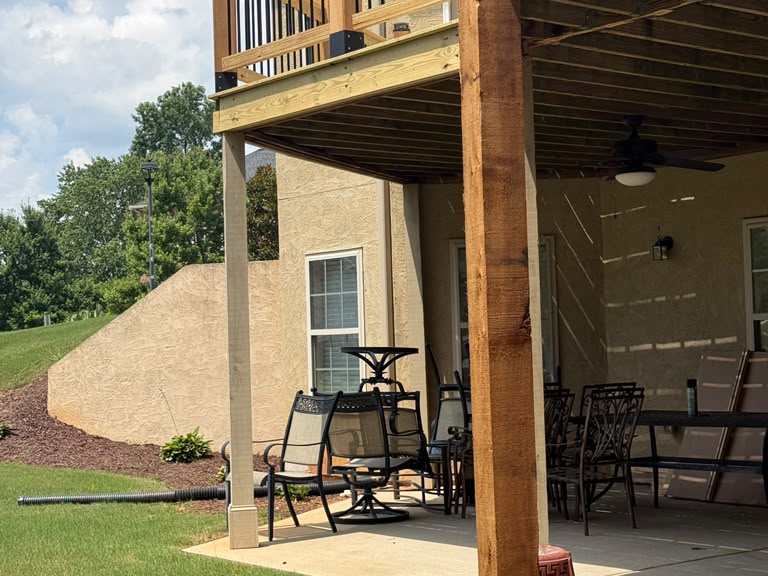
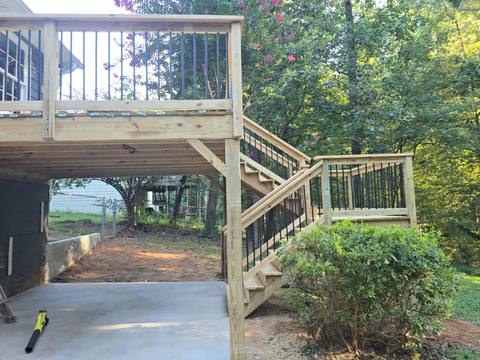
Posts are the vertical supports, and they carry the combined weight of everything above to the footings below. A post should stand plumb, meaning straight up and down, and rest on a solid footing instead of loose dirt or a stack of scraps. Ground contact is a concern, since wood that stays wet tends to rot from the bottom. A deck on a sloped lot, whether near historic downtown Ball Ground or out among the woods, often needs taller posts. Taller posts can flex or lean if they are not braced, so they deserve extra attention to bracing and footing quality.
Footings matter as much as the posts. A footing spreads the load across a wider patch of soil so the post does not sink. Soil that stays wet can soften and settle. If a footing settles, the post goes with it, and the beam and joists follow. Look for posts that lean, posts that stand on bare soil with no visible footing, and posts that are splintered at the base. Creeks and wet areas matter for another reason. Ball Ground's code has a stream buffer protection chapter and treats decks as impervious cover, so a deck close to a creek can be restricted. Confirm what applies to your address with the city or county.
Guide
Sagging and notches are warning signs
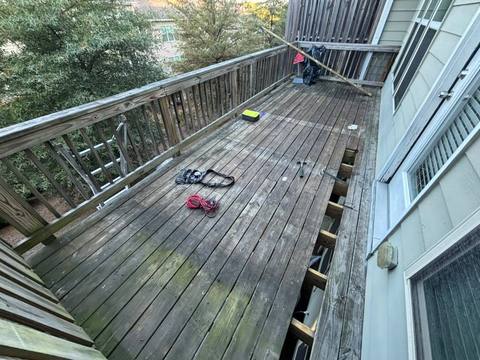
A sagging deck is the plainest warning. Sight along the edge of the deck and look for a dip, a slope toward the middle, or a gap that has opened where the deck meets the house. Posts that lean, split or show dark, soft spots near the bottom are also warnings. A notched post is one where a section was cut away so a beam could sit in the cut. That removes wood exactly where the load is concentrated, and the post can crack or crush there. A beam held only by a few fasteners driven through the side of a post is a related concern.
Connectors are the metal hardware that holds the pieces together: hangers, post caps, brackets and bolts made for outdoor wood. They matter because gravity is only one force. Wind, movement and people shifting their weight all try to pull pieces apart sideways and upward, and nails alone resist that poorly. Look for rust streaks, missing fasteners, bent metal, and joists that have slid out of their hangers. Mismatched hardware or fasteners that look too small for the job can also be trouble. Connectors are small, yet a failed one can let a whole section drop.
Guide
Photos help a pro see the problem
Good photos let a pro form a first opinion before visiting. Start with the whole deck from a distance, from a few different corners, so the overall shape shows. Then, if it is safe, photograph each post from top to bottom, the beam where it meets the post, and the footing at the ground. Take close shots of any crack, split, rust streak, gap or notch, with a coin or pencil in the frame for scale. Photograph where the deck attaches to the house too, since that connection carries a great deal of weight. Stay out from under anything that looks ready to move.
Add a few notes: how high the deck sits, and whether it feels bouncy, soft or tilted. Mention if the area stays wet after rain. Permits and association approval depend on the address, so check with the City of Ball Ground building department if you are inside city limits, or with Cherokee County if you are outside. If you have an HOA, ask the association too. We ask about HOAs up front so approval time does not surprise you. B&T builds, repairs and replaces decks, porches, rails and stairs, and a free written estimate is available after Breno visits in person.
Get a fast estimate
Local notes
Around Ball Ground and Canton and nearby
Ball Ground. Some Ball Ground subdivisions have HOAs, and older in-town and rural properties often do not. We ask up front so approval time does not surprise you. Communities in the area include Hawks Ridge, historic downtown Ball Ground.
Canton. Canton sits in the rolling Piedmont foothills of North Georgia, and a lot of backyards step down from the house instead of running flat. That changes how a deck is framed: taller posts, extra footings, and sometimes a landing partway down the stairs. Communities in the area include BridgeMill, Great Sky, Laurel Canyon, River Green.
Holly Springs. The Holly Springs waterway buffer rule is worth knowing about: it generally calls for a 50-foot buffer plus an additional 25-foot impervious buffer where permanent structures are not allowed. A creek along the back of the lot can therefore limit where a deck may go. Communities in the area include Harmony on the Lakes, downtown Holly Springs.
Straight answers
Common questions
Can I tell if a post is rotten without special tools?
Push the tip of a screwdriver into the post near the ground. If it sinks in easily or the wood crumbles, the inside may be soft. Sound wood resists. Check the bottom end too, since rot often starts there. Soft wood is a reason to call a builder before anyone leans on the rail.
Why does my deck bounce when we walk across it?
Bounce usually points to framing that spans too far, joists that have lost stiffness, or loose connections, rather than the boards themselves. A beam that has bowed can cause it too. Some movement is minor, but new or growing bounce deserves a look from a pro who can see the framing underneath.
Is a post notched to hold a beam always unsafe?
Not always, but a notch removes wood where the load is highest, and the post can split there. A beam carried on top of a post, or held between boards on either side with proper bolts, is generally a sturdier arrangement. A pro should judge any notch you find before the deck is used heavily.
If a footing has settled, does the post have to be replaced?
Sometimes the post is fine and the footing is the problem. The fix may involve lifting the beam, correcting the support, and checking the post for damage from sitting out of plumb. Because the load must be carried safely during the work, this is a job for a builder, not a weekend experiment.
Why does the connection to the house matter so much?
The house connection carries load and is often where trouble hides, since water can sneak behind it. Look for gaps, rust, soft siding or flashing that has pulled away. Bring photos of that spot with your questions. We look at that connection on every visit, along with the posts and beams.
Will stain or sealer protect posts and beams?
Sealer can slow moisture, but it cannot cure rot or fix a weak connection. The undersides and cut ends are the most exposed and the hardest to reach. Treat finishing as maintenance, and inspect the framing while you do it. A fresh coat over a soft post only hides the problem.
What if my deck is near a creek and needs new posts?
Ball Ground's code includes a stream buffer protection chapter and treats decks as impervious cover, so work near a creek or wet area can be restricted. Check with the City of Ball Ground if you are inside city limits, or Cherokee County if not, before you plan changes or order materials.
Does a screened porch use the same posts and beams?
A screened porch usually carries a roof, so its posts and beams can be asked to carry more than an open deck's. The same checks apply: plumb posts, solid footings and tight connections. Rot at the base of a porch post is common where rain splashes. We build and repair screened porches as well as decks.
Does the historic district downtown change how I repair deck framing?
Ball Ground has a National Register historic district downtown, which matters for homes in that area. Whether it affects your deck depends on your address, so confirm with the city before planning work. Also ask your HOA about approval if you have one, since that varies by property.
Verified Google reviews
What the neighbors are saying
These are verified Google reviews from B&T customers.
★★★★★
“Breno and his team exceeded our expectations. They were organized, efficient, and truly cared about delivering a high-quality result. We couldn't be happier.”
★★★★★
“Outstanding service! Breno is knowledgeable, honest, and takes pride in his work. It's hard to find a company this reliable these days.”
Who’s doing the work
About B&T Properties
B&T Properties is run by Breno, who visits the job, writes the estimate and stays involved until the work is done. The crew has 10+ years of combined deck experience, and the company carries General Liability insurance. We work in Ball Ground and across Cherokee County.
Upgrades
Add-ons to consider
Thinking beyond the basics? Mention any of these at your free estimate and Breno will go over what makes sense for your home.
Stairs and landings
A better way down to the yard, with extra width, a landing or a second flight.
Composite decking
Low-maintenance boards in a range of colors, priced next to wood so you can compare.
Railing styles
Railing is what you see first, so we go over the options before the estimate is final.
Lighting
Stair and post lights that make evenings outside safer and nicer.
Written warranty
1-year workmanship warranty
Our labor carries a written one-year warranty counted from the finish date: if our workmanship is the cause, we repair it free. The warranty excludes faulty materials (the maker’s warranty applies), ordinary wear, storm damage, misuse, skipped upkeep and other contractors’ work. Send claims in writing.
Free written estimate
Ask Breno about your deck — free and in writing.
No call center, no sales rep — the person who answers is the person who does the work.