Owner-operated · Homeowner guide
Where Does the Water Go Around and Under My Deck?Homeowner guide · Georgia decks
Where Does the Water Go Around and Under My Deck? Water from your roof and yard follows predictable paths, and many of them lead straight to the deck.
Free estimate · opens your texting app · no forms needed
Get a fast estimate
★★★★★ 31 Google reviews as of Nov 2026 — “Great workmanship, fair pricing, and excellent customer service.” Read reviews
- Free written estimate within one day
- General liability coverage
- Crews with 10+ years of combined experience
- Owner on every job
- Text us (470) 863-3707
Homeowner guide
Where Does the Water Go Around and Under My Deck?
Short answer: Knowing where it goes helps you protect the framing, the wall of the house and the ground under the deck before a small leak turns into rot.
- The owner comes to the visit and writes the estimate himself
- Crews with 10+ years of combined experience
- Insured (general liability)
- Rated 5.0 on Google across 31 reviews as of Nov 2026
- Photos from our own jobs, not stock images
Guide
Where roof runoff ends up
Rain that hits the roof runs into gutters and down the downspouts, but the story does not end at the elbow near the ground. In many neighborhoods, including established areas like Windward and Broadlands, downspouts empty onto splash blocks that sit close to deck posts. From there the water spreads across the ground and can work its way back toward the house and the ledger, where the deck attaches.
If a downspout extension is missing or crushed, the concentrated flow washes soil away from footings and keeps the area around them damp for days. Clogged gutters are just as bad: when leaves and seed pods block them, water spills over the edge and pours straight onto the deck boards and the band board behind them. Keeping gutters clear and carrying downspout water well past the deck is one of the simplest ways to protect the frame.
Guide
How yard grading moves water toward or away from the deck
The slope of the yard decides whether water runs toward the house or away from it. Most lots are graded to send water away when the house is built, but new garden beds, piled mulch, added patios and settling soil can reverse that slope without anyone noticing. When the ground tilts back toward the foundation, every storm pushes a sheet of water under the deck and against the house.
Standing water under the deck after rain is a clear sign the grade has settled or was never quite right. The soil stays soaked, the air between the joists stays humid and the framing never fully dries. Walking the yard during a steady rain is the easiest way to see where water actually goes. If it heads for the deck, a landscaper or drainage contractor can help regrade the area.
How it works
Five steps. No surprises.
Call, text, or send the form
Tell us what is going on: a new deck, a repair, or “not sure yet.” We reply the same day.
Free on-site visit
Breno looks at the deck or the yard himself, measures, and goes over your options with you.
Written estimate
Scope, materials and price come in writing, so you know the plan before anything starts.
Schedule and permits
We agree on a start date and confirm any city, county or HOA requirement for your address first.
Build and final walk-through
Breno is on the job, and we go over the finished work with you before we call it done.
Real B&T work
Photos from real jobs


Real photos from B&T projects in North Georgia.
Guide
Why water sits under the deck
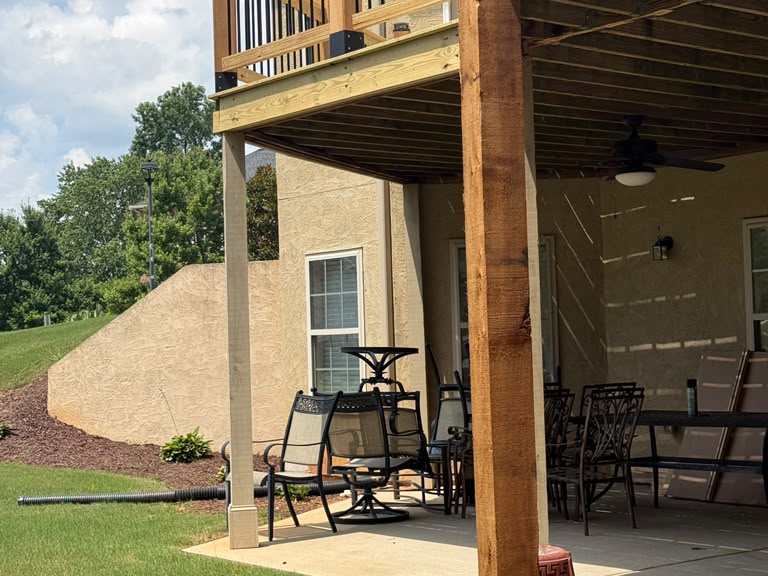
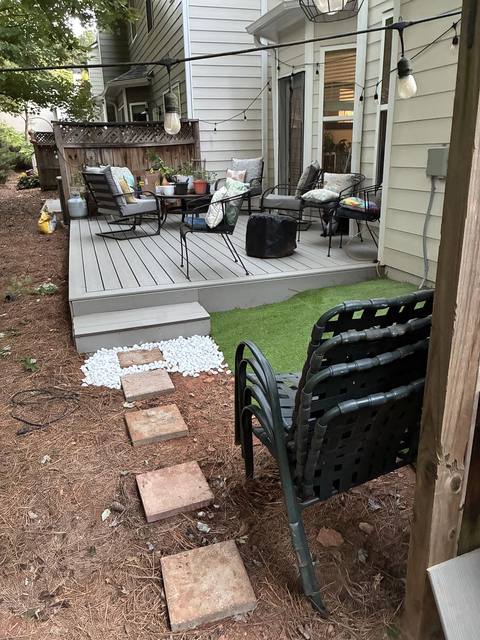
Low spots beneath a deck collect roof runoff, yard flow and drips from the boards above. Georgia clay drains slowly, so a shallow dip can hold a puddle long after the storm has passed. As that water evaporates, it rises into the spaces between the joists and keeps the wood damp even in dry weather.
Leaves and pine needles that blow under the deck make things worse by trapping moisture against posts and footings and building up a soggy layer that never dries. Clearing that debris a few times a year and making sure air can move freely under the deck, rather than closing it in with solid skirting, both help the frame dry between storms.
Guide
How splash-back damages the house wall
When rain hits a hard surface such as a concrete patio, packed soil or dense mulch, it bounces back up and wets the lower part of the siding and the area behind the ledger. This zone is easy to miss because it sits below the deck boards and behind trim. On homes where patios or walks butt right up to the foundation, splash-back can reach the bottom edge of the wall framing.
Repeated wetting wears down the finish on siding and pushes water into any small crack or nail hole. Once water gets behind the siding, it can reach the sheathing and the rim of the house, where it dries slowly. Leaving a gap between the soil and the siding, using stone instead of mulch at the drip line and carrying downspout water away from the deck all reduce the load on that wall.
Guide
Why trapped moisture shortens the life of the frame
Wood that gets wet and then dries out quickly can last a very long time. Wood that stays damp becomes food for the fungi that cause rot. Deck framing is often the slowest part of the deck to dry because it is shaded, sheltered from wind and close to damp soil or concrete. The ledger, the tops of posts and the ends of joists are the usual trouble spots.
Metal connectors and fasteners also corrode faster when they stay wet, slowly losing strength. The result can be a deck that looks fine on top while its frame quietly weakens. When we repair or replace a deck, we pay close attention to flashing at the house, gaps that let water drain, and post bases that keep wood off concrete so air can circulate.
Get a fast estimate
Local notes
Around Alpharetta and Milton and nearby
Alpharetta. Many Alpharetta communities have HOAs with architectural review for outdoor structures. Tell us your neighborhood at the start and we will plan the approval timeline with you. Communities in the area include Windward, Broadlands, downtown Alpharetta.
Milton. Milton has a Tree Canopy Conservation Ordinance, with tree removal permits required for protected trees and trees in buffers, plus a 50-foot undisturbed stream buffer and an additional 25-foot setback where impervious surface is prohibited. On a wooded Milton lot, those rules can shape the deck footprint. Communities in the area include Crabapple, Birmingham, Deerfield, Atlanta National.
Roswell. Roswell documents a tree removal permit for many residential projects, and streams in state waters are subject to stream buffers with limited alteration. Both can shape a deck footprint on a wooded lot. Communities in the area include Brookfield West, Willow Springs, Steeplechase, historic Roswell.
Straight answers
Common questions
How far should downspout water be carried away from my deck?
Far enough that it lands on ground sloping away from both the deck and the house, not on the soil around footings. Watch where the water goes during a heavy rain and extend the outlet until it clearly runs off and away.
What ground cover cuts down splash-back against the house wall?
Stone or gravel at the drip line breaks the force of falling water better than mulch or bare soil, and it does not hold moisture against the siding. Keep the ground surface a little below the bottom of the siding.
How can I tell if the ledger is staying wet from roof runoff?
After a dry spell, look at the area where the deck meets the house for dark stains, soft spots or rust streaks from fasteners. Press the wood with a screwdriver tip. If it sinks in easily, water is getting in and the ledger needs a closer look.
Will solid skirting around my deck trap moisture underneath?
It can. Solid skirting blocks airflow, so the space under the deck stays humid and the frame dries slowly. Open lattice or a design that leaves a vented gap at the bottom lets damp air escape.
How often should I clear leaves from under a low deck in Broadlands or Windward?
Check after heavy leaf drop in the fall and again in spring, and any time you see debris piling up around posts. Wet leaves hold water against the wood and speed up rot in shaded spots.
Does Breno look at drainage when he visits for a deck repair?
Yes. Breno visits in person, checks the boards, frame, rails and stairs, and notes where roof and yard water reach the deck. Those notes go into the free written estimate so the repair addresses the cause, not just the damage.
Verified Google reviews
What the neighbors are saying
These are verified Google reviews from B&T customers.
★★★★★
“Outstanding service! Breno is knowledgeable, honest, and takes pride in his work. It's hard to find a company this reliable these days.”
★★★★★
“Breno F. is an incredible man. He helped my aging mother when no one else would and went the extra mile with a complex home repair. His work is meticulous and his follow through is commendable. He is a good man with a great heart. Highly recommended!”
Who’s doing the work
About B&T Properties
Owner-operated by Breno. Collectively, our team brings 10+ years of deck-building experience, and B&T Properties carries General Liability insurance. Serving Alpharetta and the rest of Fulton County.
Upgrades
Add-ons to consider
Ask about any of these when Breno comes out for your free estimate. They are easiest to price in when we plan the project, not after it is built.
Composite decking
Boards that resist rot and skip the yearly stain. Worth pricing in at the start.
Lighting
Stair and post lights that make evenings outside safer and nicer.
Stairs and landings
Wider steps, a landing, or a second set of stairs down to the yard.
Multi-level layouts
Two levels can follow your slope and give dining and lounging their own space.
Written warranty
1-year workmanship warranty
One year, in writing, on our labor from the completion date. If our own workmanship is why something fails, B&T Properties makes it right at no cost to you. Materials fall under the manufacturer’s warranty; wear, weather, misuse, neglect and third-party work are not covered. Request service in writing.
Free written estimate
Ask Breno about your deck — free and in writing.
No call center, no sales rep — the person who answers is the person who does the work.