Owner-operated · Homeowner guide
Why Georgia Red Clay Matters for Your Deck FootingsHomeowner guide · Georgia decks
Why Georgia Red Clay Matters for Your Deck Footings Red clay holds water, and it swells and shrinks as the weather swings between wet and dry, so the soil under a deck footing does not stay still.
Free estimate · opens your texting app · no forms needed
Get a fast estimate
★★★★★ 31 Google reviews as of Nov 2026 — “Great workmanship, fair pricing, and excellent customer service.” Read reviews
- Free written estimate within one day
- General liability coverage
- Crews with 10+ years of combined experience
- Owner on every job
- Text us (470) 863-3707
Homeowner guide
Why Georgia Red Clay Matters for Your Deck Footings
Short answer: That is why footing depth and size are decided on site by the builder and the local inspector, not guessed from a chart.
- The owner comes to the visit and writes the estimate himself
- Crews with 10+ years of combined experience
- Insured (general liability)
- Rated 5.0 on Google across 31 reviews as of Nov 2026
- Photos from our own jobs, not stock images
Guide
What makes red clay behave the way it does
If you have dug a hole anywhere around Canton, you already know the color. Red clay is made of very fine particles packed close together, and that explains most of its habits. Water moves through it slowly, so rain tends to sit instead of draining away. When clay is wet it turns soft, slick and heavy. When it dries out it can harden and crack. A deck footing is a hole filled with concrete, sitting in that soil, and it has to hold a loaded deck through every one of those moods.
The ground is also not the same from one spot to the next. Canton sits in the rolling Piedmont foothills, and a shovel in one corner of the yard can hit stiff clay while another corner has looser fill left behind when the house was graded. That can be true whether your home is near Riverstone, around River Green, or out toward the Hickory Flat area. It is the reason one rule cannot cover every yard. Someone has to look at the actual dirt where each post will stand.
Guide
How wet and dry spells move the ground
Clay tends to swell a little when it takes on water and shrink when it dries. North Georgia swings between soaking spring storms and dry, hot stretches in late summer, so the soil around a footing gets pushed and relaxed again and again. The movement is usually small. Over time, though, small movement adds up, especially when one post sits in wetter ground than its neighbor. Then one corner of the deck settles or lifts more than the rest. A deck is a stiff frame, so it shows uneven movement fast.
Cold snaps and roots add to the story. Freezing weather can lift wet soil near the surface, and the ground can drop again when it thaws. Big trees pull water out of clay in dry months, which can dry one side of a yard more than the other. A footing that is deep enough and wide enough tends to reach steadier soil and spread the load over more ground. How deep and how wide is a question we answer at the site, with the dirt in front of us.
How it works
Five steps. No surprises.
Call, text, or send the form
Tell us what is going on: a new deck, a repair, or “not sure yet.” We reply the same day.
Free on-site visit
Breno looks at the deck or the yard himself, measures, and goes over your options with you.
Written estimate
Scope, materials and price come in writing, so you know the plan before anything starts.
Schedule and permits
We agree on a start date and confirm any city, county or HOA requirement for your address first.
Build and final walk-through
Breno is on the job, and we go over the finished work with you before we call it done.
Real B&T work
Photos from real jobs


Real photos from B&T projects in North Georgia.
Guide
Drainage around the posts
Water is the real troublemaker, so where it goes matters as much as the footing itself. If roof runoff, a downspout or a slope sends water toward your posts, the clay stays wet and soft right where you need it firm. Wet ground also keeps the bottom of a wood post damp, which invites rot. We look at where the gutters empty, which way the yard tilts and where water sits after a storm. Often the fix is simple: move a downspout, extend a pipe, or reshape the dirt so water walks away from the deck.
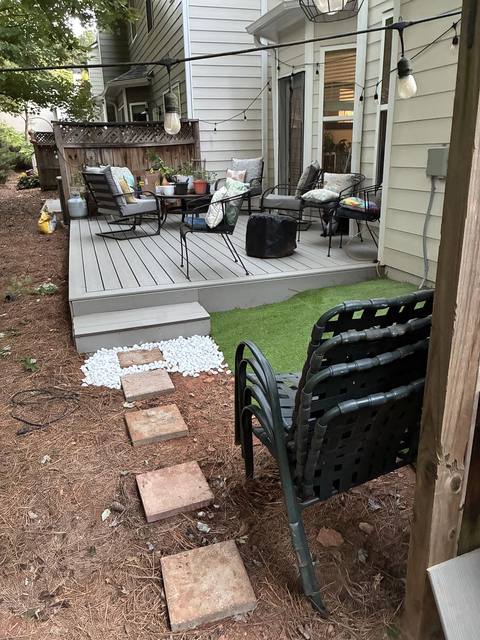
Backyards around Canton often step down from the house, so water has a natural path, and it can run right under a raised deck. That makes the ground below the deck worth planning for, not forgetting about. Some owners lay stone or add a drain path under the boards. Others leave bare dirt and wonder why a post is leaning later on. A deck on taller posts also puts more leverage on each footing, so a soft spot at the bottom shows up as wobble at the top. It is better to settle the water first.
Guide
Why the builder and the inspector decide footing depth and size
You will not find a number in this guide, and that is on purpose. Footing depth and size are decided on site by the builder and the local inspector, because they depend on the soil, the slope, the height of the deck and the load it will carry. Two yards on the same street can call for different answers. When Breno visits, we look at the ground, probe the soil, note the grade and talk through the deck you want. Then the plan gets checked against what the permitting office requires for your address.
Which office reviews it depends on where you live. The City of Canton runs its own building and permitting office, while addresses outside the city limits fall under Cherokee County, so confirm with the city, the county or your homeowner association which one applies to you. The same goes for architectural review, setbacks, stream buffers and tree rules, which can all affect where a deck is allowed to go, especially on wooded lots near creeks. We check what applies to your parcel as part of the free estimate, but please confirm the details with the office yourself too.
Guide
Signs of settling on an older deck
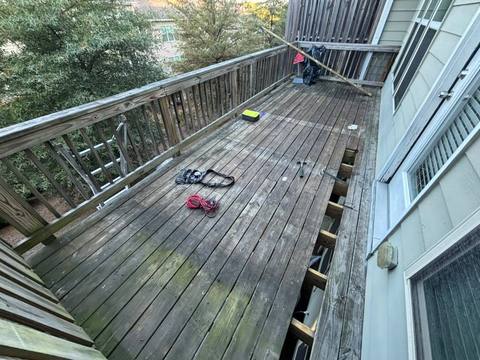
Older decks tell you when a footing is moving, if you know where to look. Check whether the deck has pulled away from the house or left a gap along the ledger. Look for boards that no longer sit level, a surface that slopes where it used to be flat, or stair treads that tilt. Doors that stick near the deck, railings that wobble and posts that lean are all worth a second look.
One sign alone is not a verdict. Wood shrinks, boards cup and fasteners loosen without any footing trouble. But two or three signs together, especially a lean or a widening gap, point toward the ground. Take a few photos now and again after the next big rain so you can compare. Do not jack, shim or pour new concrete on your own. Sometimes the answer is fixing drainage, sometimes it is replacing a footing or a post, and sometimes it is rebuilding. Breno can look at it in person, and B&T offers a free written estimate.
Get a fast estimate
Local notes
Around Canton and Woodstock and nearby
Canton. Setbacks, stream buffers and tree rules can affect where a deck is allowed to go, especially on wooded lots near creeks. We check what applies to your parcel as part of the free estimate instead of leaving you to discover it at inspection. Communities in the area include BridgeMill, Great Sky, Laurel Canyon, River Green.
Woodstock. Woodstock is a suburban North Georgia city of established subdivisions with mature trees and, in some older neighborhoods, larger lots. Shade and fallen leaves keep wood damp longer, which matters for both framing and board choice. Communities in the area include Towne Lake, Eagle Watch, Wyngate, Bradshaw Farm.
Holly Springs. The Holly Springs waterway buffer rule is worth knowing about: it generally calls for a 50-foot buffer plus an additional 25-foot impervious buffer where permanent structures are not allowed. A creek along the back of the lot can therefore limit where a deck may go. Communities in the area include Harmony on the Lakes, downtown Holly Springs.
Straight answers
Common questions
Can I pour a bigger concrete pad under a sinking post myself?
It is tempting, but a pad poured on top of soft or shifting clay often just sinks with the post. The cause might be drainage, a crushed footing or a post that has rotted. Have someone look at why it is moving first, then decide whether the fix is water control, a new footing or something else.
Does red clay mean my deck is going to fail?
No. Red clay is common across North Georgia, and decks stand on it all the time. It just asks for more care. Good footings, sensible drainage and posts kept off wet ground go a long way. The trouble comes when clay is ignored, not when it is present.
Why would two posts on one deck settle differently?
The soil under a deck is rarely uniform. One post may sit in stiff clay while another sits on fill, near a downspout, or close to a tree that drinks water in dry months. Each footing feels different moisture and different support, so they can move at different rates and twist the frame.
Is a crack in the dirt beside a post a problem?
Not always. Clay can crack when it dries in hot, dry weather and close up again after rain. It becomes worth attention when the crack grows, when soil has sunk or washed away around the post, or when the post or deck above it has started to lean.
Does someone test the soil before a deck is built?
Breno looks at and probes the ground during the visit, and the builder and local inspector make the footing call on site. Whether anything more is needed depends on the lot, the slope and the deck design. Ask the permitting office for your address what it expects to see.
Can a downspout really hurt a deck footing?
Yes, it can. A downspout that empties near a post keeps the clay wet and soft in one spot, which can let the footing move and can keep the wood damp. Moving the outlet or running the water farther away is often a small change that protects a lot.
Do these clay concerns apply in Woodstock, Holly Springs or Ball Ground?
Red clay shows up often across the North Georgia Piedmont, so the same ideas can apply near those towns. But soil still changes from lot to lot, and permit rules depend on your exact address. Confirm with your local building office, and let us look at your own yard.
Who handles the footing inspection, the city or the county?
It depends on your exact address. Homes inside Canton city limits go through the City of Canton building and permitting office, and addresses outside the limits fall under Cherokee County. If you are in an HOA, ask the association about review too. Confirm with the offices before work is scheduled.
What happens when Breno looks at an older deck that may be settling?
He walks the deck and the yard, checks posts, ledger and stairs, and looks at how water moves around the footings. Then he explains what he sees in plain language, whether that is a repair, a replacement or just better drainage, and B&T puts it in a free written estimate.
Verified Google reviews
What the neighbors are saying
These are verified Google reviews from B&T customers.
★★★★★
“If you're looking for a trustworthy contractor, B&T Properties is the right choice. Great workmanship, fair pricing, and excellent customer service.”
★★★★★
“The quality of the work was exceptional. The team was friendly, responsive, and made sure everything was done right. I would definitely recommend B&T Properties.”
Who’s doing the work
About B&T Properties
B&T Properties is run by Breno, who visits the job, writes the estimate and stays involved until the work is done. The crew has 10+ years of combined deck experience, and the company carries General Liability insurance. We work in Canton and across Cherokee County.
Upgrades
Add-ons to consider
Ask about any of these when Breno comes out for your free estimate. They are easiest to price in when we plan the project, not after it is built.
Lighting
Soft LED lighting along the steps and rail, so the deck is usable after dark.
Railing styles
Pick the rail that fits the house: aluminum, composite or wood, in several styles.
Composite decking
Low-maintenance boards in a range of colors, priced next to wood so you can compare.
Cover or screens
A roof or a screened section for shade and bug-free evenings.
Written warranty
1-year workmanship warranty
B&T Properties warrants our workmanship for one year from completion and fixes failures caused by our work at no charge. Not covered: material defects (manufacturer warranty), normal wear, weather, misuse, lack of maintenance, or work by others. Claims in writing.
Free written estimate
Ask Breno about your deck — free and in writing.
No call center, no sales rep — the person who answers is the person who does the work.