Owner-operated · Homeowner guide
What are the warning signs of damaged deck joists?Homeowner guide · Georgia decks
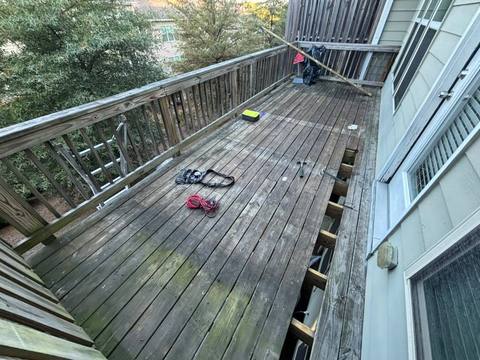
What are the warning signs of damaged deck joists? Look for a bouncy feeling when walking, visible sagging in the middle of spans, or deep cracks in the wood. Check for rot where the joists meet the ledger board and look for rusted fasteners or peeling flashing tape. If the wood feels soft, your joists are likely damaged.
Free estimate · opens your texting app · no forms needed
Get a fast estimate
★★★★★ 31 Google reviews as of Nov 2026 — “Great workmanship, fair pricing, and excellent customer service.” Read reviews
- Free written estimate within one day
- General liability coverage
- Crews with 10+ years of combined experience
- Owner on every job
- Text us (470) 863-3707
Homeowner guide
What are the warning signs of damaged deck joists?
I have spent a lot of time under decks in Canton, and I can tell you that most homeowners ignore the bones of their deck until it is too late. You might see a fresh coat of stain on top, but the joists underneath do the heavy lifting. If those fail, the whole thing goes.
- Owner-operated: Breno visits and writes your estimate himself
- A team with 10+ years of combined experience
- Insured with general liability coverage
- 31 Google reviews as of Nov 2026, rated 5.0
- Before-and-after photos from our own completed jobs
Guide
Why does my deck feel bouncy?
When you walk across your boards and feel a springy or bouncing sensation, it is usually a sign that the joists are losing their strength. This happens when the wood softens or the connections loosen up over time.
- Joists that have started to rot lose their stiffness.
- Old wood can warp, creating gaps that allow for more movement.
- Overloaded decks can cause the wood to flex beyond its limit.
If you feel that bounce, it means the structural integrity is compromised. It is not just an annoyance; it is a warning that the wood can no longer support the weight it was meant to carry.
Guide
How to spot sagging and bowing
Take a look at your deck from the side or stand back and look across the surface. If the middle of the deck dips or the beams look like they are curving downward, you have a problem.
- Sagging often happens when the wood was undersized for the span.
- Long term exposure to moisture can weaken the fibers, causing a bow.
- Heavy furniture left in one spot for a long time can create a permanent dip.
A sagging deck is a clear sign that the joists are failing to hold the load. Once the wood bows, it is much harder to fix than if you catch the rot early.
How it works
Five steps. No surprises.
Call, text, or send the form
Tell us what is going on: a new deck, a repair, or “not sure yet.” We reply the same day.
Free on-site visit
Breno looks at the deck or the yard himself, measures, and goes over your options with you.
Written estimate
Scope, materials and price come in writing, so you know the plan before anything starts.
Schedule and permits
We agree on a start date and confirm any city, county or HOA requirement for your address first.
Build and final walk-through
Breno is on the job, and we go over the finished work with you before we call it done.
Real B&T work
Photos from real jobs


Real photos from B&T projects in North Georgia.
Guide
Checking for cracks and rot at the tops
The most dangerous spot on any joist is the top edge, right where the decking boards sit. Water traps itself in those seams, and that is where the rot starts.
- Look for deep cracks that run along the grain of the wood.
- Check for "spongy" wood that gives way when you poke it with a screwdriver.
- Look for dark discoloration or fungus growing on the upper edges.
If the tops of your joists are rotting, your deck boards are essentially floating on mush. This is a major safety risk because the fasteners no longer have solid wood to grip onto.
Guide
The danger of notching and fastener rust
Sometimes builders notch the joists to make room for pipes or wires, but cutting into the structural member weakens it. Pair that with rusted hardware, and you have a recipe for collapse.
- Notches create a stress point where the wood is likely to snap.
- Rusted nails or bolts can eat through the wood fibers, making the joint weak.
- Bleeding rust stains on the wood often mean the metal is gone.
I always check the hangers and the bolts. If the metal is flaking away or the wood is split around a notch, that joist needs to be reinforced or replaced immediately.
Guide
What to look for with flashing tape
Many newer decks use flashing tape to seal the tops of the joists and keep water out. While it helps, it can also hide problems if it starts to fail.
- Peeling tape can trap moisture against the wood, accelerating rot.
- Bubbles under the tape often hide standing water.
- Torn strips of tape allow rain to soak directly into the joist ends.
If you see tape peeling away, do not just slap some glue on it. It is a sign that you need to get underneath and see if the wood stayed dry or if it has been soaking in a pocket of water.
Guide
How to inspect from underneath
The only way to know the truth about your deck is to get your head under it. Grab a bright flashlight and crawl around the perimeter to see what is actually happening.
- Check where the joists meet the house ledger board.
- Look for white powdery residue or crumbling wood.
- Feel the beams for any signs of softness or shifting.
Looking from below lets you see the things that the deck boards hide. You can see the rust on the hangers and the slope of the beams. It is the only way to be sure your family is safe.
Get a fast estimate
Guide
Knowing when to call a pro
Dealing with joists is not a weekend project for most people. If you find rot, sagging, or rusted hardware, you need a professional to tell you if the deck can be saved or if it needs a total teardown. Catching these signs early can save you from a total loss.
Guide
Get a Free Deck Health Check
Not sure where your project stands? B&T Properties will take a look and tell you plainly what we see, with no pressure. Text us at 470-863-3707 to schedule your Free Deck Health Check, and we will walk the job with you and explain your options.
Local notes
Around Canton and Holly Springs and nearby
Canton. Canton sits in the rolling Piedmont foothills of North Georgia, and a lot of backyards step down from the house instead of running flat. That changes how a deck is framed: taller posts, extra footings, and sometimes a landing partway down the stairs. Communities in the area include BridgeMill, Great Sky, Laurel Canyon, River Green.
Holly Springs. Holly Springs is mostly suburban residential, with quiet streets, big subdivisions and some larger lots. Backyards run from fairly level to gently sloping, and plenty back up to creeks or wooded buffers. Communities in the area include Harmony on the Lakes, downtown Holly Springs.
Woodstock. Several Woodstock communities, including master-planned areas like Towne Lake, operate with HOA covenants that can cover decks and screened structures. Share your HOA name with us early and we will build the approval step into the schedule. Communities in the area include Towne Lake, Eagle Watch, Wyngate, Bradshaw Farm.
Straight answers
Common questions
Can I just paint over the rot to stop it?
No, painting over rot only hides the problem. The wood is still decaying underneath, and the paint will just peel off as the wood continues to crumble.
How often should I check my joists?
I suggest taking a look once a year, preferably in the spring. This lets you see any damage caused by winter moisture and ice.
Is flashing tape always necessary?
It is a great way to extend the life of your joists. It keeps water from sitting on the wood, which prevents the rot I see so often.
Does a bouncy deck always mean it is failing?
Not always, but it is a major red flag. It could be a simple loose bolt, or it could be structural rot that needs immediate attention.
Can I replace just one joist?
In many cases, yes. If only a few joists are damaged, they can often be sistered or replaced without tearing down the whole deck.
Verified Google reviews
What the neighbors are saying
These are verified Google reviews from B&T customers.
★★★★★
“Breno did an excellent job repairing my home. He was professional, reliable, and paid close attention to every detail. The quality of his work exceeded my expectations…”
★★★★★
“Breno and his team exceeded our expectations. They were organized, efficient, and truly cared about delivering a high-quality result. We couldn't be happier.”
Who’s doing the work
About B&T Properties
B&T Properties is run by Breno, who visits the job, writes the estimate and stays involved until the work is done. The crew has 10+ years of combined deck experience, and the company carries General Liability insurance. We work in Canton and across Cherokee County.
Upgrades
Upgrades worth asking about
Ask about any of these when Breno comes out for your free estimate. They are easiest to price in when we plan the project, not after it is built.
Cover or screens
A roof or a screened section for shade and bug-free evenings.
Composite decking
Boards that resist rot and skip the yearly stain. Worth pricing in at the start.
Stairs and landings
A better way down to the yard, with extra width, a landing or a second flight.
Railing styles
Aluminum, composite or wood railing, from classic balusters to a cleaner, low-profile look.
Service area
Cities we serve
Written warranty
1-year workmanship warranty
One year, in writing, on our labor from the completion date. If our own workmanship is why something fails, B&T Properties makes it right at no cost to you. Materials fall under the manufacturer’s warranty; wear, weather, misuse, neglect and third-party work are not covered. Request service in writing.
Free written estimate
Ask Breno about your deck — free and in writing.
No call center, no sales rep — the person who answers is the person who does the work.