Owner-operated · Homeowner guide · Sandy Springs
Why Is My Sandy Springs Deck Always Damp, Slick or Soft?Sandy Springs · Fulton County
Sandy Springs: A deck that never seems to dry out is telling you something, and the message is not always bad news. Owner-operated, with a free written estimate.
Free estimate · opens your texting app · no forms needed
Get a fast estimate
★★★★★ 31 Google reviews as of Nov 2026 — “Great workmanship, fair pricing, and excellent customer service.” Read reviews
- Free written estimate within one day
- General liability coverage
- Crews with 10+ years of combined experience
- Owner on every job
- Text us (470) 863-3707
Homeowner guide · Sandy Springs
Why is my deck always damp, slick or soft?
Here is how we sort the harmless surface problems from the ones that mean real repair for homeowners in Sandy Springs.
- Breno, the owner, measures and writes your estimate
- 10+ years of combined team experience
- General liability insurance
- 5.0 stars from 31 Google reviews as of Nov 2026
- Real before-and-after photos from our own jobs
Sandy Springs
Shade and slow drying are the usual starting point
The damp decks we look at often share one simple story: the boards never get a chance to dry. A deck sitting under tall trees can stay wet long after a rainstorm has passed. Morning dew, humid summer air and a thick canopy that blocks the sun all keep moisture on the surface. Wood that stays wet grows algae and mildew, and that green or black film is what makes boards slick under your feet. The good news is that a film on the surface is usually cosmetic. A careful cleaning and a fresh protective finish can often bring the deck back, as long as the wood underneath is still firm.
Shade is not something you can fix with a brush, so the goal is to help the deck dry faster. Trimming back low branches, where the tree rules allow, can let in more light and air. Keep in mind that Sandy Springs has a Tree Conservation Ordinance, and larger trees and trees in stream buffers can need a permit, so check with the city before anyone cuts. Moving planters and furniture off the boards also helps, because anything sitting flat on a deck traps water against the wood and leaves a dark ring behind.
Sandy Springs
Leaves, pine needles and debris hold water against the wood
Leaf debris does more harm than most people expect. Wet leaves, pine needles and seed pods packed into the gaps between boards act like a sponge, and they hold moisture against the sides of every board all season. Homes on wooded lots near Grogans Bluff, or on streets off Roswell Road with mature trees, tend to see this every fall. The debris blocks the small gaps that let water drain and air move. Over time, the wood along those gaps stays wet, turns dark and starts to break down faster than the rest of the board.
Sweeping the surface is only half the job. Use a thin tool, like a putty knife or a stiff plastic scraper, to pull packed debris out from between the boards. Do the same along the edge where the deck meets the house, and around posts and stair treads, since leaves collect in those corners. Gutters matter too. If a gutter above the deck overflows, it can pour water onto the same spot again and again. A deck that gets cleaned a few times a season usually stays slick-free far longer than one that waits for spring.
How it works
Five steps. No surprises.
Call, text, or send the form
Tell us what is going on: a new deck, a repair, or “not sure yet.” We reply the same day.
Free on-site visit
Breno looks at the deck or the yard himself, measures, and goes over your options with you.
Written estimate
Scope, materials and price come in writing, so you know the plan before anything starts.
Schedule and permits
We agree on a start date and confirm any city, county or HOA requirement for your address first.
Build and final walk-through
Breno is on the job, and we go over the finished work with you before we call it done.
Real B&T work
Photos from real jobs


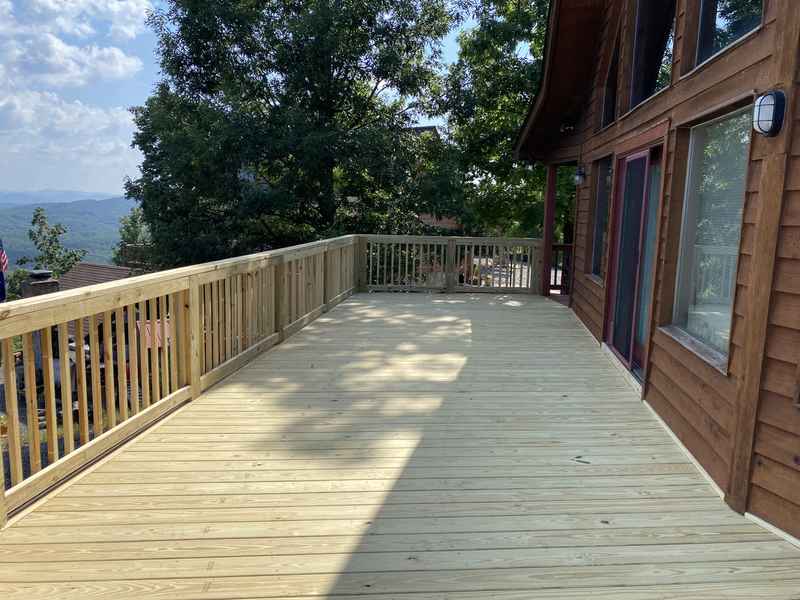
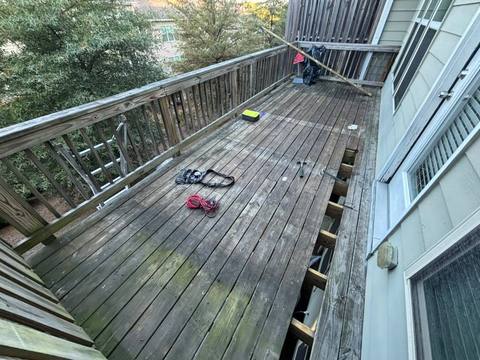
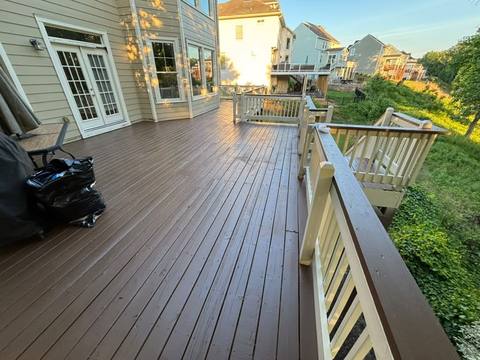
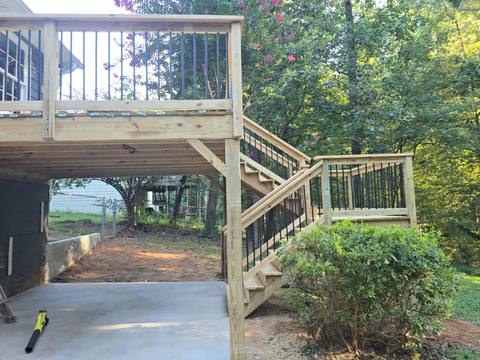
Real photos from B&T projects in North Georgia, not necessarily from Sandy Springs.
Sandy Springs
Poor drainage and airflow under the deck
Look under your deck, because that is where a lot of dampness begins. A deck needs air moving beneath it so the underside of the boards can dry. If the ground below is bare dirt that stays soggy, or if water runs downhill and pools under the frame, the whole structure sits in a damp pocket. Many lots here are wooded and slope toward the water, so runoff can be a real issue. Homes near Johnson Ferry Road or around Huntcliff may have very different ground conditions from one lot to the next, which is why we look at each yard in person.
Good airflow and a dry footing are the fixes. Keep plants, stored items and piled leaves away from the lattice or skirting so air can pass through. If water collects under the deck, the ground may need regrading, or the downspouts may need to be pointed away from the frame. Be careful here, though. Sandy Springs has stream buffers and a regulated river corridor, and work near the water can be limited. Before anyone digs or moves soil near a creek, confirm what applies to your address with the city.
Sandy Springs
Trapped water at board ends and where the deck meets the house
Water gets trapped in a few predictable places, and these are where soft spots show up first. The cut ends of boards soak up water like a straw, so they often rot before the middle of the board does. Joints where one board meets another, spots around screws and the tops of the joists can hold moisture for days. The other big trouble spot is the ledger, the board where the deck attaches to the house. If water gets behind it, the damage is hidden. Flashing that was missing, installed poorly or has worn out can let water run behind the ledger every time it rains.
Check these places yourself on a dry day. Look at the board ends for dark staining, cracks or crumbling. Check the wall just above the deck for stains, peeling paint or soft siding, because a leak at the house often shows up there first. Look at the tops of the joists from underneath, where flat surfaces hold water. Surface staining on a board end is one thing. A dark, spongy end that crumbles is another. If you find rot at the house connection, call us soon, since that area carries a lot of the deck's load.
Get a fast estimate
Sandy Springs
What is cosmetic and what means repair
Here is the plain version. Cosmetic problems include green or black film, gray weathered color, surface mildew, small hairline cracks that do not go deep and a finish that has worn thin. These make a deck look tired and feel slick, but a good cleaning and a new finish usually handle them. Repair problems feel different. A board that gives or bounces when you step on it, a screwdriver that sinks easily into the wood, a railing post that wiggles and stairs that flex are all warning signs. Soft wood that crumbles means the fibers have broken down, and no stain will fix that.
Do a simple test. On a dry day, press a screwdriver tip into the board ends, the ledger area and the posts near the ground. Firm wood pushes back. Rotten wood lets the tip sink in or flakes away in chunks. If you only find a few soft boards, replacing them can be enough. If the framing, the ledger or the posts are soft, that is a bigger job and worth a professional look. Breno will come out, look at the whole deck in person, and give you a free written estimate that explains what must be fixed and what can wait. Buyers and neighbors in Buckhead, Dunwoody and Roswell ask us the same thing.
Straight answers
Sandy Springs homeowner questions
Why is my deck slick even when it has not rained?
Slick boards without rain usually mean algae or mildew growing on a surface that stays damp from dew, humidity or shade. The film is thin but slippery. A thorough cleaning often removes it, and a fresh finish helps slow it from coming back. If boards stay slick after cleaning, look for trapped moisture.
How can I tell if my deck is soft from rot or just old?
Press a screwdriver tip into the wood on a dry day. Old, gray wood is usually still firm and only rough on the surface. Rotten wood lets the tip sink in easily or crumbles into soft flakes. Check board ends, posts near the ground and the area by the house first.
Do leaves between the boards really cause damage?
Yes, they can. Packed leaves and needles hold water against the sides of the boards and block the gaps that let the deck drain and dry. That constant dampness encourages rot and mildew. Clearing the gaps with a thin scraper a few times each season is simple and genuinely helps the wood last.
Is it normal for a deck near I-285 or GA-400 to stay damp?
Location near a highway does not decide it. What matters is shade, tree cover, drainage and how the deck was built. We check those details in person at each home.
Where does water usually get in where the deck meets the house?
Water most often gets behind the ledger board when flashing is missing, poorly installed or worn out. It then runs down behind the board without showing. Stains on the wall above the deck, soft siding or rot at the rim are signs. This spot deserves a close, careful look.
Can I just stain or seal a damp, soft deck?
Stain will not repair soft wood, and it can trap moisture if applied over damp boards. Clean the deck, let it dry fully and replace any rotten boards first. Then a finish can protect sound wood. Putting finish over rot only hides the problem for a short while.
Do I need a permit to repair or replace deck boards in Sandy Springs?
It depends on your address and the scope of the work, so confirm with the City of Sandy Springs building division. Small board swaps and larger structural repairs may be treated differently. We tell you what your address and project will need before work is scheduled, and we can walk through it with you.
Should I worry about my HOA before repairing or replacing my deck?
If your community has architectural review, check with your association before work starts, since rules differ by community. Share them with us early so materials, railings and colors can be approved before building. Breno can visit, look at the deck and give you a free written estimate.
Verified Google reviews
What the neighbors are saying
These are verified Google reviews from B&T customers.
★★★★★
“The quality of the work was exceptional. The team was friendly, responsive, and made sure everything was done right. I would definitely recommend B&T Properties.”
★★★★★
“Outstanding service! Breno is knowledgeable, honest, and takes pride in his work. It's hard to find a company this reliable these days.”
Who’s doing the work
About B&T Properties
You deal with the owner. Breno visits, quotes and oversees the work, and the crew brings more than ten years of deck experience between them. B&T carries General Liability insurance, and Sandy Springs is part of our regular service area.
Upgrades
Add-ons to consider
Thinking beyond the basics? Mention any of these at your free estimate and Breno will go over what makes sense for your home.
Multi-level layouts
A split-level layout that works with the lay of your lot instead of fighting it.
Cover or screens
Shade, rain cover or screens, planned in from the start.
Railing styles
Pick the rail that fits the house: aluminum, composite or wood, in several styles.
Stairs and landings
Wider steps, a landing, or a second set of stairs down to the yard.
Written warranty
1-year workmanship warranty
B&T Properties warrants our workmanship for one year from completion and fixes failures caused by our work at no charge. Not covered: material defects (manufacturer warranty), normal wear, weather, misuse, lack of maintenance, or work by others. Claims in writing.
Free written estimate
Tell Breno about your Sandy Springs deck — free and in writing.
No call center, no sales rep — the person who answers is the person who does the work.