Owner-operated · Homeowner guide
When Should Deck Stair Stringers Be Replaced, Not Patched?Homeowner guide · Georgia decks
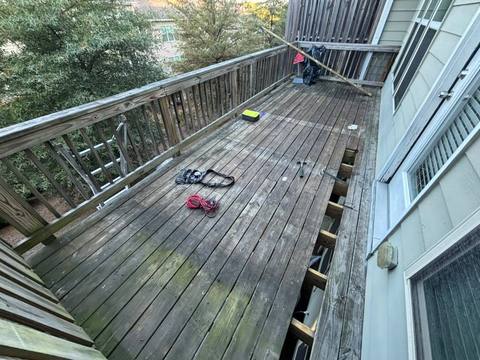
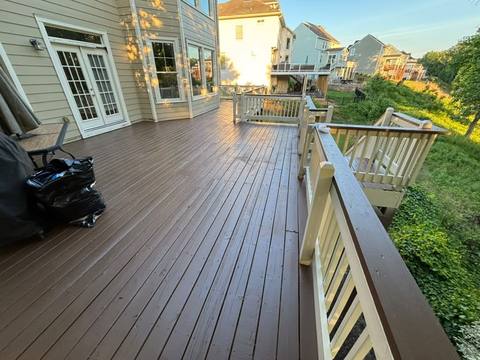
When Should Deck Stair Stringers Be Replaced, Not Patched? Deck stair stringers should usually be replaced when the wood is rotted, split through, or too weak to hold the steps firmly, or when the connections at the top and bottom cannot be made solid again.
Free estimate · opens your texting app · no forms needed
Get a fast estimate
★★★★★ 31 Google reviews as of Nov 2026 — “Great workmanship, fair pricing, and excellent customer service.” Read reviews
- Free written estimate within one day
- General liability coverage
- Crews with 10+ years of combined experience
- Owner on every job
- Text us (470) 863-3707
Homeowner guide
When Should Deck Stair Stringers Be Replaced, Not Patched?
Short answer: Patching can work for small surface flaws, but stairs carry people at their most unsteady moments, so a repair that only looks good is not worth the risk.
- Owner-operated: Breno visits and writes your estimate himself
- A team with 10+ years of combined experience
- Insured with general liability coverage
- 31 Google reviews as of Nov 2026, rated 5.0
- Before-and-after photos from our own completed jobs
Guide
Are cracked or rotted stringers fixable?
A stringer is the sloped board that carries every step and every person who walks on them. Small surface flaws, such as a shallow check along the grain or a hairline split near a nail, can sometimes be sealed and watched. Real rot is different. If a screwdriver sinks into the wood, if the board feels spongy, or if pieces flake off near the ground, the strength inside is probably gone. Wet and dry cycles across the North Georgia Piedmont can break wood down, including on decks near Polo Golf & Country Club.
Patching rot usually means bolting a new board beside a weak one and hoping the pair share the load. That approach tends to hide the problem instead of solving it, because the old board keeps decaying and can pull moisture into the new one. Cracks that run through the notches where the treads sit are especially serious, since that is where the wood is already thinnest. When we see a split across a cut-out section, we nearly always recommend a new stringer rather than a clamp, a plate or a bead of filler.
Guide
Why do my deck steps bounce?
Bounce in the steps is a warning, not a quirk. A solid staircase should feel like part of the ground, with no give, no sway and no creak when someone steps on it. Movement can come from a stringer that has softened, from treads that have lost their grip on the board, or from connections that have worked loose. Because the cause is hidden, a quick tightening of screws sometimes makes the stairs feel better for a short while without fixing anything underneath.
The test we like is simple: stand on a middle step, shift your weight side to side, and watch the whole run. If the stringers flex, twist or shift against the deck frame, the structure itself is the issue. Longer runs of stairs, such as those serving a tall rear deck, tend to show weakness sooner. Homeowners driving along Highway twenty or Bethelview Road often tell us the steps felt fine until a heavy delivery or a full family gathering made the movement obvious.
How it works
Five steps. No surprises.
Call, text, or send the form
Tell us what is going on: a new deck, a repair, or “not sure yet.” We reply the same day.
Free on-site visit
Breno looks at the deck or the yard himself, measures, and goes over your options with you.
Written estimate
Scope, materials and price come in writing, so you know the plan before anything starts.
Schedule and permits
We agree on a start date and confirm any city, county or HOA requirement for your address first.
Build and final walk-through
Breno is on the job, and we go over the finished work with you before we call it done.
Real B&T work
Photos from real jobs


Real photos from B&T projects in North Georgia.
Guide
What about loose connections at the top and bottom?
The top of a stringer hangs from the deck frame, and the whole staircase depends on that joint. Look for pulled nails, rusted brackets, gaps between the stringer and the rim board, or wood that has crushed around a fastener. If the framing behind the connection is soft, new hardware will not hold, because a screw is only as good as the wood gripping it. In that case the stringer and the framing behind it may both need work, and a bigger repair is the honest answer.
The bottom matters just as much. Stringers that sit directly on soil, or on a pad that has sunk or shifted, wick up moisture and rot from the cut ends inward. A solid landing, with the stringer held clear of constant dampness, helps the stairs last. Near Buford Dam Road and other spots where the ground holds water after storms, we often find the foot of the stringer is the oldest damage on the whole deck.
Guide
Does a sloped yard change the answer?
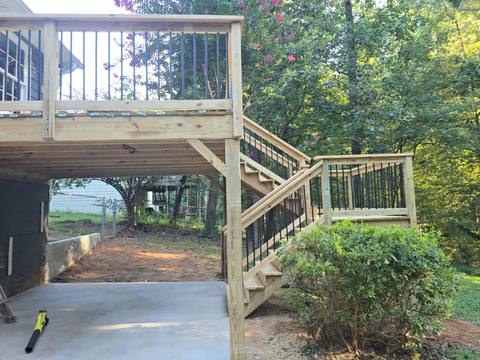
Yes, because slope changes how much a staircase has to do. Around Cumming, rolling Piedmont lots mean many rear decks sit high above the grade, and the stairs may run long, turn at a landing, or end on ground that falls away. Longer spans put more stress on each stringer, and uneven ground can make the bottom step shift as soil settles or washes out. A patch that worked on a short, level run may not be enough for a tall staircase on a hillside.
Drainage matters too. Water running downhill can undercut the base of the stairs, soften the soil under the landing and keep the lower wood wet. Wooded and lake-adjacent parcels can add shade and moisture that slow drying. Setbacks, drainage and tree rules can also affect where stairs may go, so a rebuild sometimes needs a look at the whole parcel. Your city or county permit office and any homeowners association can tell you what applies to your exact address.
Guide
What does a pro check before deciding?
A careful inspection starts at the ground and works upward. We probe the wood with a tool, check the cut ends and notches, look for rot hidden behind treads, and measure how the stairs sit relative to the deck, though we never rely on eyes alone. We test the fasteners, the brackets and the framing behind them. We watch for movement under load, look at the landing, and note how water drains around the base. Rails and posts get checked as well, since stairs and guards work together.
Then Breno explains what he finds in plain language, with a clear line between what can be saved and what should be replaced. Sometimes the answer is a small repair; sometimes it is new stringers, new connections and a firmer landing. Homes in Windermere, Vickery, downtown Cumming and nearby Johns Creek, Alpharetta and Milton all get the same visit. A free written estimate is available from B&T, and permits and association approvals are confirmed for your address.
Get a fast estimate
Local notes
Around Cumming and Johns Creek and nearby
Cumming. Cumming is North Georgia Piedmont country: rolling hills, wooded parcels and, toward the east, properties influenced by Lake Lanier. Lots range from smaller in-town parcels to larger wooded or lake-adjacent ones. Communities in the area include Windermere, Vickery, Polo Golf & Country Club, downtown Cumming.
Johns Creek. Johns Creek is a suburb known for its golf and country-club communities, including Country Club of the South, St. Ives and Medlock Bridge. Many homes here have outdoor spaces that were planned as part of the house. Communities in the area include Country Club of the South, Medlock Bridge, St. Ives Country Club.
Alpharetta. Alpharetta is a mix of established suburban subdivisions, master-planned communities and some larger-lot neighborhoods, with tree-lined yards and moderate slopes rather than steep ground. Communities in the area include Windward, Broadlands, downtown Alpharetta.
Straight answers
Common questions
Can I tell by sight alone whether a stringer is rotted?
Not always. Rot often starts on cut ends, under treads and near the ground, where you cannot see it. Dark, soft or crumbling wood is a clear sign, but a sound-looking surface can hide damage. Probing with a screwdriver tip and checking from underneath gives a much better picture than looking from above.
Is it safe to use stairs that have a single cracked stringer?
It depends on where the crack is and how deep it runs. A crack through a notch or near a connection can fail without warning. Until someone qualified looks at it, keep children and heavy loads off the stairs, and avoid carrying furniture or grills up and down them.
Why do my steps feel firm in dry weather but soft after rain?
Wood that is already decayed absorbs water and loses even more strength. Dry weather can make a weak board feel stiff, while rain can reveal the softness. Seasonal change in how the stairs feel is a good reason to have the stringers probed rather than waiting for the next storm to prove it.
Will adding extra boards beside a stringer make it strong again?
Sometimes, if the original wood is sound and the new board is tied in properly. When the old stringer is rotted, an added board just leans on a failing partner. It also traps moisture between the two. If the original is soft or split through, replacing it is the more dependable path.
What causes the bottom of a stringer to fail first?
Constant moisture. Ends that touch soil, mulch or a sunken pad stay damp, and damp wood decays from the cut face inward. Splashing runoff and leaf buildup make it worse. Raising the stringer onto a stable, well-drained landing slows that process and gives the stairs a longer working life.
Do I need a permit just to replace stair stringers?
It depends on your address and the scope of work. Inside the City of Cumming, permits go through the city, and outside the city limits they go through the county. Ask the right office before work starts, and tell us what they say so the plan fits.
Does my homeowners association need to approve a stair rebuild?
Possibly. If your community has architectural review, changes to stairs, landings or visible materials may need approval. Check your own association documents or contact the board, and tell us at the start of the project so plans and approvals fit together without surprises.
Should the rails and posts be fixed at the same time as the stairs?
Often, yes. Stair rails are anchored to the same framing, and a weak stringer can let posts wobble. If the stairs are opened up for replacement, it is the easiest time to check the guards, the post connections and the grip along the stair side for loose or rotted parts.
How do I know if a deck needs only stair work or a bigger repair?
Check the framing where the stairs attach. If the rim board, joists or ledger near that spot are soft or pulled apart, the problem reaches beyond the stairs. If the deck frame is sound and only the stairs are worn, a focused replacement may be enough. An in-person visit settles the question.
Verified Google reviews
What the neighbors are saying
These are verified Google reviews from B&T customers.
★★★★★
“The quality of the work was exceptional. The team was friendly, responsive, and made sure everything was done right. I would definitely recommend B&T Properties.”
★★★★★
“Breno and his team exceeded our expectations. They were organized, efficient, and truly cared about delivering a high-quality result. We couldn't be happier.”
Who’s doing the work
About B&T Properties
You deal with the owner. Breno visits, quotes and oversees the work, and the crew brings more than ten years of deck experience between them. B&T carries General Liability insurance, and Cumming is part of our regular service area.
Upgrades
Add-ons to consider
Thinking beyond the basics? Mention any of these at your free estimate and Breno will go over what makes sense for your home.
Stairs and landings
Stairs that are easier to use: more width, a mid-level landing, or a better path to the yard.
Railing styles
Railing is what you see first, so we go over the options before the estimate is final.
Cover or screens
Shade, rain cover or screens, planned in from the start.
Composite decking
Boards that resist rot and skip the yearly stain. Worth pricing in at the start.
Written warranty
1-year workmanship warranty
For 12 months after we finish, B&T Properties stands behind its labor in writing. A problem traced to how we built or repaired it is corrected at no cost. Excluded: defective materials, age-related wear, weather events, improper use, missing maintenance, and anyone else’s repairs. Put your claim in writing.
Free written estimate
Ask Breno about your deck — free and in writing.
No call center, no sales rep — the person who answers is the person who does the work.