Owner-operated · Homeowner guide · Buckhead
Rot, Termites or Carpenter Bees on a Buckhead Deck: How to TellBuckhead · Fulton County
Buckhead: You are carrying a tray of drinks across the deck on a Saturday afternoon when one board gives a little underfoot, and you notice a neat round hole beside the rail and a dusting of sawdust below it. Owner-operated, with a free written estimate.
Free estimate · opens your texting app · no forms needed
Get a fast estimate
★★★★★ 31 Google reviews as of Nov 2026 — “Great workmanship, fair pricing, and excellent customer service.” Read reviews
- Free written estimate within one day
- General liability coverage
- Crews with 10+ years of combined experience
- Owner on every job
- Text us (470) 863-3707
Homeowner guide · Buckhead
Is it rot, termites or carpenter bees chewing my deck?
Is it rot, termites or carpenter bees chewing your deck, and does it need a quick fix or a closer look at the frame?
- Breno, the owner, measures and writes your estimate
- 10+ years of combined team experience
- General liability insurance
- 5.0 stars from 31 Google reviews as of Nov 2026
- Real before-and-after photos from our own jobs
Buckhead
What rot looks and feels like
Wood rot is a fungus, and it needs moisture, so it shows up where water sits: board ends, around screws and nails, the tops of joists, and under planters or mats. Look for wood that is dark, soft, or cracked across the grain into small blocks. Rotted wood often smells musty and feels spongy when you press it. A dry gray surface is usually just weathering and not rot. Rot tends to spread outward from a wet spot, so damage usually forms a patch instead of a neat tunnel.
A deck shaded by tall trees, like you might find on a wooded lot near Peachtree Heights, tends to stay damp longer, which gives fungus more time to work. Check low spots where leaves collect, the gaps between boards where debris packs in, and the places where the stair stringers meet the ground. If a board looks fine on top, check its underside and edges. Rot often starts out of sight, and the surface can look sound while the wood below it is turning soft.
Buckhead
What termite damage looks like
Termites usually work inside the wood, so the surface can look almost normal while the board is hollowed out underneath. Signs can include thin mud tubes running up posts or along the foundation, small piles of tiny pellets, and wings left on a sill or the deck floor. Tapping a damaged board often gives a dull, papery sound. When you cut or pry into it, you may see galleries that follow the grain, often with a layered, honeycomb look, and with little or no musty smell.
Termite damage tends to show up where wood touches soil or stays damp, so posts, stair bottoms and framing near the ground deserve a close look. Homes around Tuxedo Park and other older parts of Buckhead may have mature landscaping that holds moisture against wood, though any deck can be affected. Rot and termites often travel together, because damp wood draws both. If you see mud tubes or hollow wood, call a pest professional, and we can then repair the structure.
How it works
Five steps. No surprises.
Call, text, or send the form
Tell us what is going on: a new deck, a repair, or “not sure yet.” We reply the same day.
Free on-site visit
Breno looks at the deck or the yard himself, measures, and goes over your options with you.
Written estimate
Scope, materials and price come in writing, so you know the plan before anything starts.
Schedule and permits
We agree on a start date and confirm any city, county or HOA requirement for your address first.
Build and final walk-through
Breno is on the job, and we go over the finished work with you before we call it done.
Real B&T work
Photos from real jobs


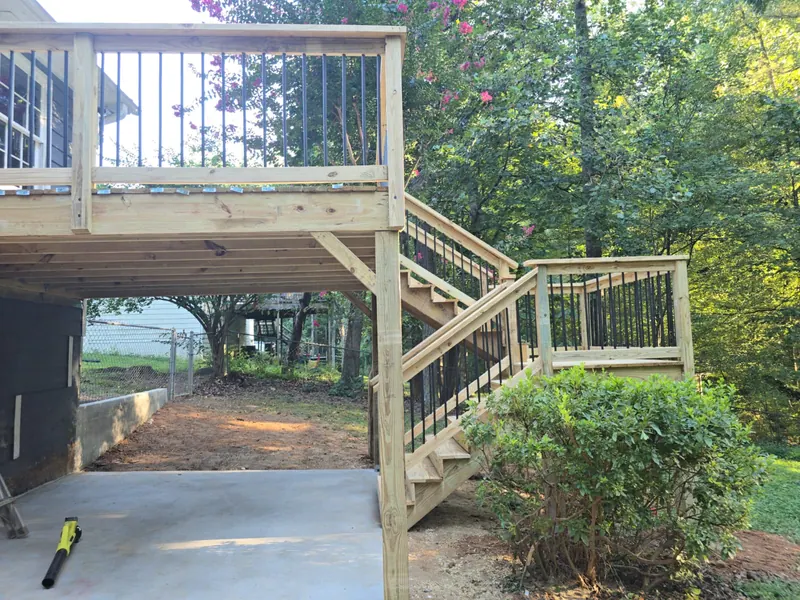
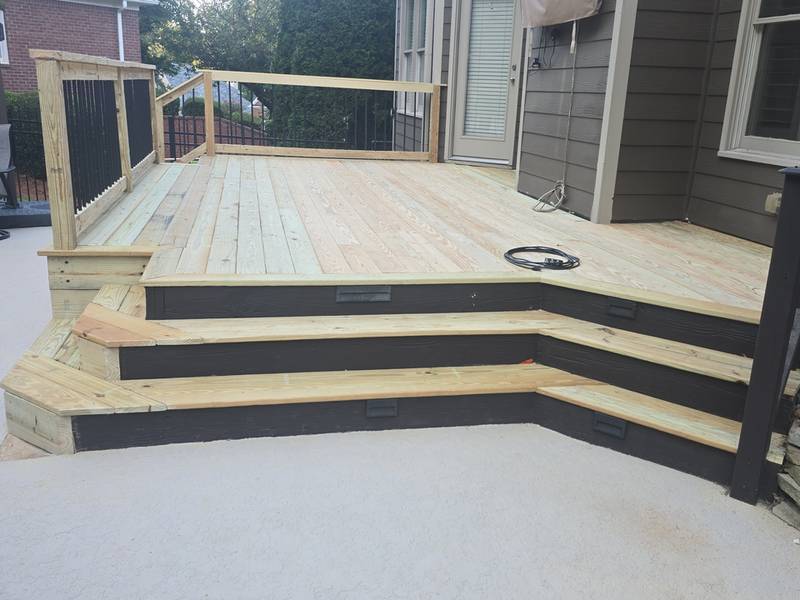
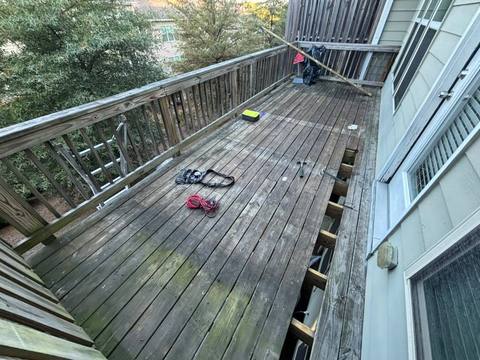
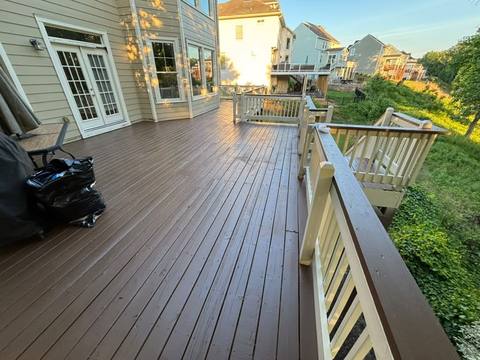
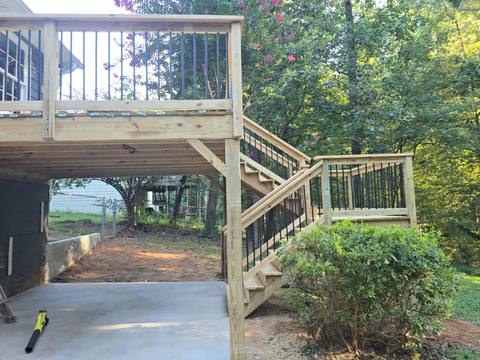
Real photos from B&T projects in North Georgia, not necessarily from Buckhead.
Buckhead
What carpenter bees leave behind
Carpenter bees do not eat wood the way termites do. They bore a clean, round entrance hole into a board, then turn and tunnel along the grain to make a nursery. The hole looks like it was drilled with a bit, and below it you will often find coarse sawdust and sometimes yellowish streaks of waste. You may see large, glossy bees hovering near the rail, fascia or underside of the deck. Rails, rim boards, post tops and the faces of bare wood are common targets.
Carpenter bee damage is usually limited to a few spots, but it should not be ignored. Old tunnels can hold water, and water leads to rot, and woodpeckers sometimes tear into the wood to reach the larvae. A hole by itself does not mean the deck is failing. What matters is how deep the damage runs, whether it is near a structural piece, and whether the same boards are being reused year after year. Painted or stained wood tends to attract them less than bare wood.
Buckhead
How to probe safely and what to photograph
Use a screwdriver with a firm hand, not a hammer. Press the tip into suspect wood at the board ends, the joist tops, the post bases and the rail posts. Sound wood resists and splinters in long fibers. Rotted wood sinks in easily and breaks off in short crumbs. Termite-hollowed wood may collapse into a thin shell. Stay off any section that feels bouncy, and never crawl under a deck you suspect is unsafe. Test several places and compare them with an area you know is healthy.
Before you touch anything, photograph it. Take a wide shot of the whole deck, then a medium shot of each problem area, then a close shot with a coin or pencil beside it for scale. Photograph the underside, the posts, the stair stringers, and the line where the deck meets the house. Shoot the sawdust, the holes and any mud tubes. Take the pictures in daylight and add a flashlight shot of dark corners. Send them to us or a pest professional so we can see what you see.
Get a fast estimate
Buckhead
Why the frame and ledger matter more than the surface
Surface boards are the part you see, but the frame carries the load. The joists, beams, posts and the ledger, the board that fastens the deck to your house, hold up people, furniture and weather. A bad deck board can be swapped in an afternoon. A soft ledger or a rotted post cannot be fixed with a patch. Damage there can mean the deck pulls away or sags, and it can let water into the house wall. That is why we look at the framing first and the boards second.
The ledger area is the trouble spot because water runs down the house wall and pools behind the board, where you cannot easily see it. Check for stains on the siding above, soft spots under the flashing, rust on the fasteners, and gaps between the ledger and the wall. Whether your deck sits near Roswell Road, in North Buckhead or on a sloped lot near Chastain Park, the same rule holds: inspect the structure. Breno visits in person, probes the frame, and gives a free written estimate for repair or replacement.
Straight answers · Buckhead
Buckhead homeowner questions
Does one round hole in my rail mean carpenter bees?
A clean, round hole about the size of a finger with coarse sawdust beneath it usually points to carpenter bees. Look for large glossy bees nearby. Termites and rot do not leave neat, drilled holes. Take a close photo, and if the hole sits in a post or beam, have the structure checked.
Can I treat the damage myself and skip a repair?
Surface treatments can help protect sound wood, but they do not restore wood that is already soft or hollow. If a screwdriver sinks in or the board crumbles, the piece usually needs replacing. Treating the wood first and then covering weak framing with new boards can hide a real problem.
Which should I call first, a pest company or a deck builder?
If you see mud tubes, pellets or hollow wood, a pest professional should confirm and treat the insects. A deck builder then repairs the damage. If it looks like moisture damage only, we can start with the structure. Either way, share your photos with whoever you call.
Is a spongy board always a sign of rot?
Usually it is, but not always. A board can feel soft from age, from cracks or from a loose fastener. Probe the wood nearby and the framing underneath. If the joist below is firm and the board alone is soft, it may be a simple board swap. If the joist is soft too, the problem goes deeper.
What should I look for around the ledger board?
Check for stains on the siding above, dark or soft wood along the ledger, rusty or loose fasteners, and gaps where it meets the wall. Water behind the board is the main concern. Photograph anything odd, and do not stand on the deck while testing if it moves or feels weak.
Can carpenter bees ruin a deck on their own?
Usually they cause limited damage, but repeated nesting in the same wood can weaken it over time. The bigger risk is that open tunnels let water in, and rot follows. Filling holes and finishing bare wood can help, and structural pieces with deep tunnels may need to be replaced.
Does a deck near trees rot faster?
Shade and falling leaves keep wood damp, and damp wood is where rot and insects do their right work. A wooded or sloped lot can make this more likely. Sweeping out debris, keeping plants from touching the wood and letting air flow under the deck all help. Regular checks matter more than the lot.
Will repairs need a permit or association approval?
It depends on the address and the scope of the work. Buckhead is part of the City of Atlanta, so confirm requirements with the city, and check with your civic association or HOA if you have one. We look into the permitting portal for your address and tell you what we find.
Verified Google reviews
What the neighbors are saying
These are verified Google reviews from B&T customers.
★★★★★
“The quality of the work was exceptional. The team was friendly, responsive, and made sure everything was done right. I would definitely recommend B&T Properties.”
★★★★★
“If you're looking for a trustworthy contractor, B&T Properties is the right choice. Great workmanship, fair pricing, and excellent customer service.”
Who’s doing the work
About B&T Properties
You deal with the owner. Breno visits, quotes and oversees the work, and the crew brings more than ten years of deck experience between them. B&T carries General Liability insurance, and Buckhead is part of our regular service area.
Upgrades
Add-ons to consider
Ask about any of these when Breno comes out for your free estimate. They are easiest to price in when we plan the project, not after it is built.
Multi-level layouts
Two levels can follow your slope and give dining and lounging their own space.
Stairs and landings
Stairs that are easier to use: more width, a mid-level landing, or a better path to the yard.
Composite decking
Low-maintenance boards in a range of colors, priced next to wood so you can compare.
Cover or screens
Shade, rain cover or screens, planned in from the start.
Written warranty
1-year workmanship warranty
B&T Properties warrants our workmanship for one year from completion and fixes failures caused by our work at no charge. Not covered: material defects (manufacturer warranty), normal wear, weather, misuse, lack of maintenance, or work by others. Claims in writing.
Free written estimate
Tell Breno about your Buckhead deck — free and in writing.
No call center, no sales rep — the person who answers is the person who does the work.