Owner-operated · Homeowner guide
How Board Direction and Patterns Change the Look of a DeckHomeowner guide · Georgia decks
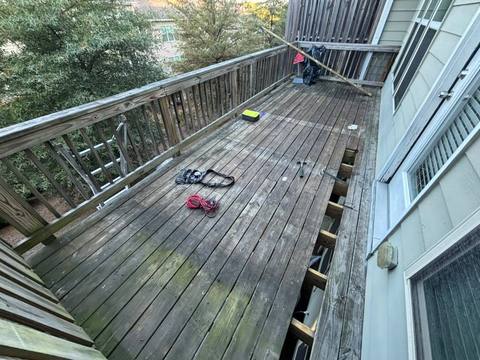
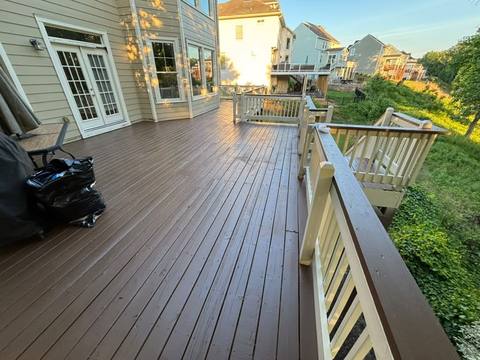
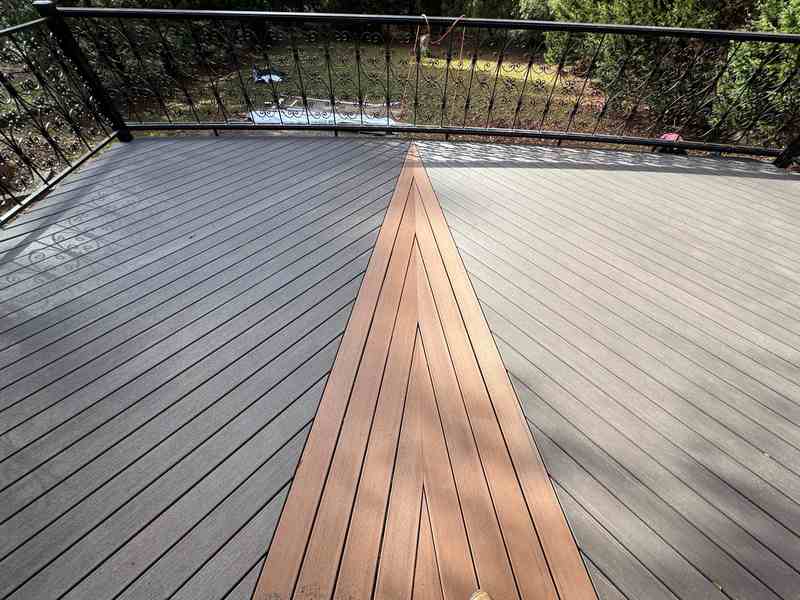
How Board Direction and Patterns Change the Look of a Deck You sit down with morning coffee and your eyes follow the boards out toward the yard, so how do board direction and pattern change the way a deck looks?
Free estimate · opens your texting app · no forms needed
Get a fast estimate
★★★★★ 31 Google reviews as of Nov 2026 — “Great workmanship, fair pricing, and excellent customer service.” Read reviews
- Free written estimate within one day
- General liability coverage
- Crews with 10+ years of combined experience
- Owner on every job
- Text us (470) 863-3707
Homeowner guide
How Board Direction and Patterns Change the Look of a Deck
Short answer: Straight runs read calm and wide, diagonals add energy, picture-frame borders add polish, and breaker boards tidy long spans, and each choice also changes waste, drainage and how big the deck feels.
- Owner-operated: Breno visits and writes your estimate himself
- A team with 10+ years of combined experience
- Insured with general liability coverage
- 31 Google reviews as of Nov 2026, rated 5.0
- Before-and-after photos from our own completed jobs
Guide
Straight runs: the calm, forgiving baseline
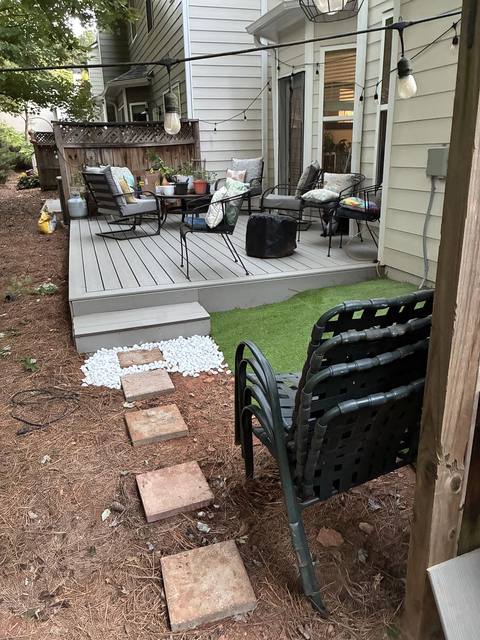
Straight boards run parallel to one another, either along the house or out away from it. Most builders start here because the layout is quick to lay, easy to repair and kind to the framing. A straight run tends to read like a clean floor, a calm surface that keeps your attention on the yard instead of on the deck. On a deck behind a home near East Main Street, that quiet look often suits older siding and mature landscaping. Fewer angled cuts also mean fewer exposed ends that can split or soak up water.
Direction still matters even in the simplest layout. Boards running away from the house draw the eye outward and can make a shallow deck feel deeper. Boards running parallel to the house emphasize width and can make a deep deck feel broad. Because the boards must sit properly across the joists, the direction you pick sometimes changes the framing as well as the look. Long runs also show their seams, so we plan where board ends land and stagger them to keep a visible stripe from forming across the surface.
Guide
Diagonal boards: more movement, more work
Diagonal boards turn the surface so the lines cut across the deck instead of following it. The effect is livelier, and it can disguise a deck that is slightly out of square with the house. The angle leads the eye toward the corners and the yard. The trade-off is labor and structure. Each board crosses the framing at a slant and spans farther between supports, so the joists often need to sit closer together or have blocking added. Every board end gets an angled cut, which takes longer and needs careful fastening so the ends stay flat.
Diagonal layouts also change how a deck behaves outdoors. Water tends to run along the grain, so angled boards can carry runoff toward the edges instead of straight at the house. Leaves and grit can travel along the gaps and settle at low corners, so expect to sweep more often. On a sloping lot, such as one in the Hickory Flat area, a diagonal pattern can soften the blocky look of a tall deck. Just remember that taller framing already adds posts and footings, so the pattern is one more thing to plan.
How it works
Five steps. No surprises.
Call, text, or send the form
Tell us what is going on: a new deck, a repair, or “not sure yet.” We reply the same day.
Free on-site visit
Breno looks at the deck or the yard himself, measures, and goes over your options with you.
Written estimate
Scope, materials and price come in writing, so you know the plan before anything starts.
Schedule and permits
We agree on a start date and confirm any city, county or HOA requirement for your address first.
Build and final walk-through
Breno is on the job, and we go over the finished work with you before we call it done.
Real B&T work
Photos from real jobs


Real photos from B&T projects in North Georgia.
Guide
Picture-frame borders and breaker boards
A picture-frame border runs a ring of boards around the edge of the deck, usually with mitered corners, and fills the middle with a field of boards in another direction. It gives the deck a finished, furniture-like edge and hides the raw ends of the field boards. It also lets you use a contrasting color if you want one. The downside is effort and upkeep. The frame needs solid support underneath, so extra blocking is common, and the mitered corners must be cut tightly or gaps show. Borders also expose more end grain, which tends to take on water first, so sealing cut ends matters.
A breaker board is a cross board set over the framing that breaks a long run into shorter sections. Deck boards come only in limited lengths, so on a long deck a breaker turns an accidental seam into a planned design line. It can also separate two directions, such as straight boards on the main deck and diagonal boards near a landing. A breaker should sit over properly supported framing, with small gaps left on both sides so water can drain. Without those gaps, the board can hold moisture and become the first spot to show wear.
Guide
How pattern affects waste and drainage
Pattern changes how much lumber ends up in the scrap pile. Straight runs waste the least, because most boards are cut to length once and the offcut often finds a use elsewhere. Diagonals leave triangular offcuts at every edge, and short wedges are rarely reusable, so plan to order noticeably more boards. Picture frames add mitered cuts and a second set of boards. Breaker boards can reduce waste on long decks by letting shorter pieces do useful work. A builder who plans the layout on paper before cutting will usually waste less than one who figures it out on the fly.
Drainage deserves just as much thought. Gaps between boards let water fall through, and flow along the grain tends to carry runoff off the surface. Patterns that create pockets, such as tight picture-frame corners or a breaker with no gap, can trap water and debris and keep wood damp longer. In humid Georgia summers, that dampness tends to invite mildew and rot. A deck shaded by trees, whether in River Green or elsewhere around Canton, stays wet even longer. Leave small gaps, keep seams swept, and let air reach the underside.
Guide
Visual width, and choosing for your own yard
Lines pull the eye. Boards running across the short dimension of a deck stripe it and can make a narrow deck look wider, while boards running the long way stretch it. Diagonals tend to make a small deck feel larger because the eye travels a longer path. A dark border can frame the space neatly but also shrinks it visually, while a border close in color to the field keeps things open. Furniture and a grill hide much of the pattern anyway, so picture what will show around your table before you pay for detail nobody will see.
Start with how you use the deck, then the shape of the lot, then how much extra material and labor you want to take on. Permit rules depend on your exact address, so confirm with the City of Canton or Cherokee County, whichever covers your property. If your home near BridgeMill or elsewhere is in an HOA community, ask the association whether it reviews exterior changes before you settle on a design. Breno visits in person, talks through layouts on your actual deck, and offers a free written estimate.
Get a fast estimate
Local notes
Around Canton and Woodstock and nearby
Canton. Canton sits in the rolling Piedmont foothills of North Georgia, and a lot of backyards step down from the house instead of running flat. That changes how a deck is framed: taller posts, extra footings, and sometimes a landing partway down the stairs. Communities in the area include BridgeMill, Great Sky, Laurel Canyon, River Green.
Woodstock. Several Woodstock communities, including master-planned areas like Towne Lake, operate with HOA covenants that can cover decks and screened structures. Share your HOA name with us early and we will build the approval step into the schedule. Communities in the area include Towne Lake, Eagle Watch, Wyngate, Bradshaw Farm.
Holly Springs. Holly Springs is a fast-growing Cherokee County city of sprawling subdivisions such as Harmony on the Lakes, with some homes on lots of an acre or more. Many houses date from the early 2000s and later, so a lot of original builder decks are now at the age where they need attention. Communities in the area include Harmony on the Lakes, downtown Holly Springs.
Straight answers
Common questions
Can I run a diagonal field inside a straight border?
Yes, and it is a common pairing. The border gives the edge a crisp, finished line while the diagonal field adds movement in the middle. It does need extra blocking under the frame, and the mitered corners must be cut carefully. Plan the border first so the diagonal boards end cleanly against it.
Does a diagonal pattern really make a small deck feel bigger?
It often does, because the eye follows a longer path across the surface instead of stopping at the edges. The effect is modest, though. Furniture, railings and color matter just as much. If space is tight, a lighter, single-tone surface with a diagonal field usually feels more open than a busy mix.
Why does a diagonal deck need so many more boards than a straight one?
Every diagonal board ends in an angled cut, and the leftover triangles are usually too short to use again. Straight runs let an offcut become the start of the next board. Diagonals also cover the same area with more cutting, so the scrap pile grows even when the deck is the same size.
Do breaker boards have to be a contrasting color?
No. A breaker can match the field for a quiet look, or contrast for a deliberate design line. The more important details are support and spacing. It should sit over solid framing with small gaps on both sides so water drains. A matching color simply hides the seam better.
Does the pattern I pick change how often the deck needs maintenance?
Indirectly, yes. Patterns with more cut ends, such as borders and diagonals, expose more end grain that takes on water first. Those spots may need sealing and checking more often. Straight runs have fewer exposed ends, so they tend to be the easiest to keep dry and tidy.
Can a pattern hide a frame that is not quite square?
Sometimes. A diagonal field or a border can draw the eye away from a wall or edge that is slightly off, because the lines no longer echo it. It is not a fix for a failing frame, though. If the structure is weak, we recommend repairing it before choosing a surface pattern.
How does board direction affect stairs on a stepped backyard?
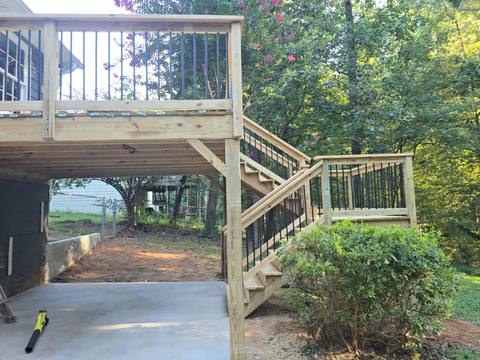
Stair treads usually run across the width of the stairs regardless of the deck field, so the deck boards and the treads can meet at different angles. A breaker board or border at the top landing can make that change look planned instead of awkward, especially when a landing sits partway down.
Is a picture-frame border worth it on a small deck?
It can be, since a border gives even a modest deck a finished look. But on a very small surface it can chop up the space and eat into the field. A border in a color close to the field usually works better there than a bold contrast.
Which pattern is easiest to repair later?
Straight runs, by a wide margin. A damaged board can often be pulled and replaced without disturbing its neighbors. Diagonals and borders involve angled or mitered pieces that must be recut to match, so a repair takes more care. Keep a few spare boards from the original job if you can.
Verified Google reviews
What the neighbors are saying
These are verified Google reviews from B&T customers.
★★★★★
“If you're looking for a trustworthy contractor, B&T Properties is the right choice. Great workmanship, fair pricing, and excellent customer service.”
★★★★★
“Breno and his team exceeded our expectations. They were organized, efficient, and truly cared about delivering a high-quality result. We couldn't be happier.”
Who’s doing the work
About B&T Properties
You deal with the owner. Breno visits, quotes and oversees the work, and the crew brings more than ten years of deck experience between them. B&T carries General Liability insurance, and Canton is part of our regular service area.
Upgrades
Upgrades worth asking about
Thinking beyond the basics? Mention any of these at your free estimate and Breno will go over what makes sense for your home.
Lighting
Stair and post lights that make evenings outside safer and nicer.
Multi-level layouts
Two levels can follow your slope and give dining and lounging their own space.
Railing styles
Pick the rail that fits the house: aluminum, composite or wood, in several styles.
Composite decking
Low-maintenance boards in a range of colors, priced next to wood so you can compare.
Written warranty
1-year workmanship warranty
One year, in writing, on our labor from the completion date. If our own workmanship is why something fails, B&T Properties makes it right at no cost to you. Materials fall under the manufacturer’s warranty; wear, weather, misuse, neglect and third-party work are not covered. Request service in writing.
Free written estimate
Ask Breno about your deck — free and in writing.
No call center, no sales rep — the person who answers is the person who does the work.