Owner-operated · Homeowner guide
Why Deck Screws, Brackets and Flashing Matter So MuchHomeowner guide · Georgia decks
Why Deck Screws, Brackets and Flashing Matter So Much You set a tray of burgers on the deck rail, feel it shift under your hand, and spot an orange streak running down the board beside the grill, so why do screws, brackets and flashing matter so much?
Free estimate · opens your texting app · no forms needed
Get a fast estimate
★★★★★ 31 Google reviews as of Nov 2026 — “Great workmanship, fair pricing, and excellent customer service.” Read reviews
- Free written estimate within one day
- General liability coverage
- Crews with 10+ years of combined experience
- Owner on every job
- Text us (470) 863-3707
Homeowner guide
Why Deck Screws, Brackets and Flashing Matter So Much
Short answer: They are the small parts that hold the deck together and keep it attached to the house, and when they rust or fail, boards stain, rails loosen and water gets into the framing where you cannot see it.
- Breno, the owner, measures and writes your estimate
- 10+ years of combined team experience
- General liability insurance
- 5.0 stars from 31 Google reviews as of Nov 2026
- Real before-and-after photos from our own jobs
Guide
What the Small Metal Parts Actually Do
A deck looks like a surface of boards, but underneath it is a chain of connections. Screws hold boards to joists, brackets hold joists to beams and to the house, and connectors tie posts to footings and rails to posts. On a worn deck the wood is often not the first thing to give up. The metal that joins it is. When one link weakens, the load shifts to the links beside it, and the whole structure starts to move a little more each season. Homeowners around Cumming usually notice a spongy board or a shaky rail long before they think about the hardware.
Hardware choice matters because the lumber itself is hard on metal. Pressure treated wood carries preservatives that can corrode some metals faster than bare wood would, and thin or plain steel tends to rust wherever moisture sits. North Georgia gets plenty of rain and humid summers, and a shaded deck on a wooded lot near Highway 20 can stay damp for long stretches. Fasteners and connectors made for outdoor use with treated lumber are chosen for exactly this job. Using whatever was in the garage is how a deck that looks fine ends up weak underneath.
Guide
How Rust Streaks and Stained Boards Happen
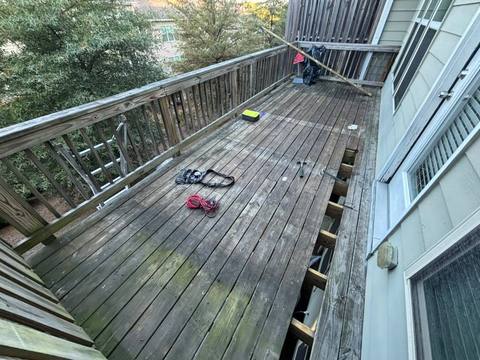
Rust streaks are the most visible warning. When steel corrodes, the orange or brown residue washes out with every rain and runs down the board face, the joist or the siding below. You will often see it as a trail starting at a screw head or a bracket and ending several inches away. On certain woods, the iron in a failing fastener can also react with natural compounds in the board and leave dark gray or black rings around each screw. The streak itself is cosmetic, but it tells you the metal behind it is losing its coating.
Wrong hardware is a common cause of stains that will not wash off. Screws with a thin plated finish can lose that finish when they are driven in, and the exposed steel then bleeds into the board. Mixing different metals in one connection can speed corrosion too. Once a stain soaks into the grain, cleaning may fade it but rarely removes it completely. On shaded back decks around Polo Golf & Country Club and similar settings, a stain that keeps coming back after cleaning is usually a hint that the fastener underneath needs to be replaced, not scrubbed again.
How it works
Five steps. No surprises.
Call, text, or send the form
Tell us what is going on: a new deck, a repair, or “not sure yet.” We reply the same day.
Free on-site visit
Breno looks at the deck or the yard himself, measures, and goes over your options with you.
Written estimate
Scope, materials and price come in writing, so you know the plan before anything starts.
Schedule and permits
We agree on a start date and confirm any city, county or HOA requirement for your address first.
Build and final walk-through
Breno is on the job, and we go over the finished work with you before we call it done.
Real B&T work
Photos from real jobs


Real photos from B&T projects in North Georgia.
Guide
Flashing Where the Deck Meets the House
The most serious water problem on many decks sits at the house wall. The board that attaches the deck to the house, called the ledger, takes rain running down the siding, plus splashes from the deck surface. Flashing is the thin metal or membrane layered so that water is guided out and away instead of into the gap behind the ledger. When flashing is missing, badly lapped or replaced with a bead of caulk, water can sit against the framing and the house rim for a long time, and the damage stays hidden until something softens.
Signs of trouble are often visible from inside and outside the home. Look for stains on the siding just above the deck, bubbling paint, a musty smell, or soft spots in the framing seen from a basement or crawl space ceiling. Older in-town homes near downtown Cumming and houses off Bethelview Road are as exposed as any others, since the issue is water and design, not location. Do not pull siding or pry at the ledger yourself. A pro can look at how the deck was attached and tell you whether the flashing needs to be redone.
Guide
Checking an Older Deck for Loose Connectors
You can learn a lot with a flashlight and a calm walk around. Look under the deck for brackets that are rusted through, flaking, bent or pulling away from the wood. Check that every bracket still has its fasteners and that none have backed out. Watch for gaps where a joist should sit tight in its hanger, and for nuts or washers missing from bolts. Rust blooms around a bracket, dark wet wood next to metal, and fasteners that seem to have been replaced with whatever was handy are all worth noting.
Then test the deck from the top. Walk the edges and stairs slowly and feel for bounce or sway. Grip each railing post and push gently to see if it moves at its base. Press on boards near screw heads that look raised or stained. Stay out from under the deck if the structure feels unstable, and never pry at connectors. A few loose pieces do not always mean the deck is finished, but they tell a builder where to look and what to repair before a bigger problem develops.
Guide
What to Photograph for a Pro
Good photos save time and make a visit more useful. Start with wide shots of the whole deck from the yard and from the stairs, then step closer to each problem area. Take clear close-ups of rust streaks, stained screw heads, loose rails and any bracket that looks bent or corroded. Add a shot of the spot where the deck meets the house, including the siding above it, and one looking up from beneath the deck with the flash on. Place a coin or pencil next to damage so size is clear.
Add short notes of where each photo was taken, such as northeast corner or the stair post. Also mention anything you noticed, like a wobble, a smell or a stain that keeps returning. B&T offers free written estimates, and Breno visits in person to look at the deck himself, so photos are a starting point and not a replacement. Permit rules and HOA requirements depend on your exact address, so confirm with the City of Cumming or the county, and with your association, before work begins.
Get a fast estimate
Local notes
Around Cumming and Johns Creek and nearby
Cumming. Cumming sits along the GA-400 corridor north of Atlanta, with a mix of older in-town homes, 1990s and 2000s subdivisions and newer master-planned communities such as Windermere, Vickery and Polo Golf & Country Club. Outdoor living space is a big part of what homeowners there ask for. Communities in the area include Windermere, Vickery, Polo Golf & Country Club, downtown Cumming.
Johns Creek. Johns Creek documents a 50-foot undisturbed stream buffer plus an additional 25-foot setback where impervious surface is prohibited, along with controls on tree removal. On a lot with a creek, those can decide where a deck fits. Communities in the area include Country Club of the South, Medlock Bridge, St. Ives Country Club.
Alpharetta. Alpharetta's ordinances address stream buffers, which generally have to stay undisturbed, and tree-related review can come into play near specimen trees. We check those constraints while we plan the deck. Communities in the area include Windward, Broadlands, downtown Alpharetta.
Straight answers
Common questions
Why do black rings show up around the screws on my boards?
Iron from a corroding or poorly coated screw can react with natural compounds in some woods and leave dark rings. The ring is often a sign that the fastener finish has worn off. Cleaning may fade it, but the rings tend to return unless the screws underneath are replaced with ones made for outdoor use.
Can I just paint over a rusty bracket and move on?
Paint can slow surface rust on a bracket that is still solid, but it will not restore metal that has already flaked or thinned. If the bracket is pitted, bent or crumbling, covering it hides the problem. Have a pro look at it, because load bearing connectors are usually replaced rather than painted.
Is a little orange on a joist hanger something to worry about?
Light surface rust on a solid hanger may only need watching, while heavy flaking, holes or swelling around the metal is more serious. Photograph it now and compare after the next rainy stretch. If it spreads fast or the wood next to it feels soft, ask a builder to check it.
Why is a bead of caulk along the house wall not the same as flashing?
Caulk dries, shrinks and cracks as it ages, and it only seals a seam from the surface. Flashing is layered so water runs over it and out, even when something leaks. Relying on caulk alone can let water creep behind the ledger, where it may stay hidden and keep the framing wet.
Can I tell if the ledger is pulling away from the house without crawling under the deck?
Sometimes. From the yard, look for a visible gap between the deck and siding, a deck that seems to tilt away, or boards near the house that bounce more than the rest. Inside, check the ceiling or wall below for stains. Do not test it by hand; ask a pro to inspect.
Should I photograph my deck wet or dry?
Both can help. Dry light shows cracks, loose parts and stain patterns clearly, while a damp deck after rain can reveal where water runs and pools. If you only have time for one, choose a dry, bright day, and add a note about where water seems to collect after storms.
Will replacing only the stained boards fix the stain problem?
Not always. If the cause is a corroding fastener, new boards fastened with the same kind of screws can stain again. A good repair looks at what caused the stain and swaps the hardware too. That is why it helps to point out stained spots during the visit.
How do I know if a loose rail post is a hardware problem or a wood problem?
Gently push the post and watch the base. If the bolts or connectors move or look rusty, hardware is likely involved. If the wood around them feels soft or crumbles, rot may be the cause, or both. Either way, a wobbly rail is a safety issue worth having checked soon.
Does a permit apply if I only want connectors and flashing replaced?
It depends on your exact address and on how much work is involved. Inside the City of Cumming, permits go through the city, and outside the limits they go through the county. Your HOA may also have its own review. Confirm with the right office, and we will help you work out what applies.
Verified Google reviews
What the neighbors are saying
These are verified Google reviews from B&T customers.
★★★★★
“The quality of the work was exceptional. The team was friendly, responsive, and made sure everything was done right. I would definitely recommend B&T Properties.”
★★★★★
“Breno F. is an incredible man. He helped my aging mother when no one else would and went the extra mile with a complex home repair. His work is meticulous and his follow through is commendable. He is a good man with a great heart. Highly recommended!”
Who’s doing the work
About B&T Properties
You deal with the owner. Breno visits, quotes and oversees the work, and the crew brings more than ten years of deck experience between them. B&T carries General Liability insurance, and Cumming is part of our regular service area.
Upgrades
Make it yours: popular upgrades
Ask about any of these when Breno comes out for your free estimate. They are easiest to price in when we plan the project, not after it is built.
Cover or screens
Add a roof over part of the deck, or screen it in for shade and fewer bugs.
Railing styles
Pick the rail that fits the house: aluminum, composite or wood, in several styles.
Composite decking
Boards that resist rot and skip the yearly stain. Worth pricing in at the start.
Multi-level layouts
A split-level layout that works with the lay of your lot instead of fighting it.
Written warranty
1-year workmanship warranty
Workmanship warranty: one year from the day we complete the work, in writing. Faults that come from our labor are repaired at no charge. Not included: manufacturer material defects, normal wear and tear, weather, misuse, no maintenance, repairs by other parties. Submit claims in writing.
Free written estimate
Ask Breno about your deck — free and in writing.
No call center, no sales rep — the person who answers is the person who does the work.