Owner-operated · Homeowner guide
What Makes Deck Stairs Comfortable and SafeHomeowner guide · Georgia decks
What Makes Deck Stairs Comfortable and Safe Deck stairs feel comfortable and safe when every step matches the others, landings break up long runs, lighting shows each edge, and the handrail is easy to grip.
Free estimate · opens your texting app · no forms needed
Get a fast estimate
★★★★★ 31 Google reviews as of Nov 2026 — “Great workmanship, fair pricing, and excellent customer service.” Read reviews
- Free written estimate within one day
- General liability coverage
- Crews with 10+ years of combined experience
- Owner on every job
- Text us (470) 863-3707
Homeowner guide
What Makes Deck Stairs Comfortable and Safe
Short answer: Add a plan for wet leaves, moss and sloping ground, and stairs on a wooded East Cobb lot stay steady in every season.
- Owner-operated: Breno visits and writes your estimate himself
- A team with 10+ years of combined experience
- Insured with general liability coverage
- 31 Google reviews as of Nov 2026, rated 5.0
- Before-and-after photos from our own completed jobs
Guide
Even steps keep your feet confident
Your body learns a stair rhythm within a few steps and trusts it without thinking. When one step is taller or shorter than the others, even by a little, your foot lands where it expects a surface and finds air or a hard edge instead. That is how people stumble on stairs they have used for ages. Even spacing from the top step to the bottom matters more than almost any other detail. It is also the detail that goes wrong when stairs sit on uneven ground, or when a footing settles and one end of the frame sinks.
Tread depth matters too. A tread that is too shallow makes you turn your foot sideways, while a generous one lets your whole foot rest, which is easier on knees and on anyone carrying laundry or a grill tray. Worn, cupped or loose boards change the feel of a step, so press on each one with your foot. A board that flexes or squeaks may mean the fasteners or framing underneath need attention. When Breno visits, he checks the rhythm of the whole run, not just the surface boards.
Guide
Landings give you a place to pause
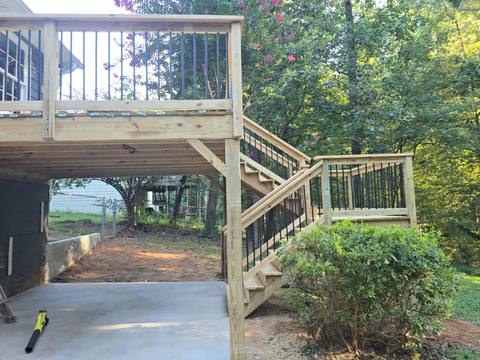
A landing is a flat platform partway down a long run, or at the bottom where the stairs meet the yard. It gives you a spot to stop, shift a load, open a gate or let a child catch up. A long, unbroken flight makes a slip more costly, because nothing stops a fall until the ground does. If your home is near Indian Hills and your yard falls away behind the house, a deck can sit high off the grade, which makes a mid-run landing worth discussing. A landing should be sturdy, level and roomy enough to turn around on comfortably.
Sloped yards add a second problem, which is the bottom step. On a hillside the ground at the foot of the stairs can be soft, tilted or washed out after heavy rain, so the last step ends up taller than the rest or sits on shifting soil. A firm, level pad on solid footing gives the stairs a stable end point. Drainage matters as well, since water crossing the base can undermine it. Whether your home is near Shallowford Road or on a quiet side street, we look at the grade in person before suggesting a layout.
How it works
Five steps. No surprises.
Call, text, or send the form
Tell us what is going on: a new deck, a repair, or “not sure yet.” We reply the same day.
Free on-site visit
Breno looks at the deck or the yard himself, measures, and goes over your options with you.
Written estimate
Scope, materials and price come in writing, so you know the plan before anything starts.
Schedule and permits
We agree on a start date and confirm any city, county or HOA requirement for your address first.
Build and final walk-through
Breno is on the job, and we go over the finished work with you before we call it done.
Real B&T work
Photos from real jobs


Real photos from B&T projects in North Georgia.
Guide
Lighting should show every edge
Stairs are where you most need to see, and where deck lighting is most often missing. Shadows from trees and the house can hide the edge of a tread even on a bright afternoon, and after dark a dim step is easy to misjudge. Low, shielded lights aimed at the treads, or small lights tucked into the risers or posts, show each edge without glare in your eyes. A single harsh floodlight tends to throw hard shadows across the steps. Light the top and bottom especially, since those are the places people hesitate. A switch near the door means you will actually use it.
Think about contrast as well as brightness. Boards that have weathered to a uniform gray can make steps blend together, and a worn finish can hide where one tread ends and the next begins. A clean, fresh stain can help the eye pick out each edge. Lighting also helps guests who do not know your stairs. If your home is near Powers Ferry Road or anywhere else, evening visitors are often carrying plates and drinks, wearing unfamiliar shoes and watching the conversation instead of their feet. Wiring should be done carefully, with fixtures made for outdoor use.
Guide
Handrails ought to feel good in the hand
A handrail is only useful if your hand wants to hold it. Rails that are rounded enough for your fingers to wrap around tend to feel secure, while a flat, wide top makes it hard to grip when you are off balance. Smooth, well-sanded wood feels far better than a rail with splinters, raised grain or sharp edges. The rail should run along the whole flight so your hand does not have to let go midway, and it should end in a way that does not catch a sleeve or a bag strap. Sturdy posts matter, because a rail that wobbles teaches you not to trust it.
Test your own rails by leaning on them, gently at first. Any movement at the posts, loose fasteners or soft spots in the wood are worth fixing before the next storm or party. Think about who uses the stairs: children, older relatives, a dog on a leash. Some households benefit from a rail on both sides. Grip applies to the treads, too. Boards with clean edges and a sound surface give shoes something to hold, and stairs that are kept sealed or stained tend to stay less slick. Rail repair and replacement are work we do.
Guide
Wet leaves and moss call for a plan
Wet leaves are the classic hazard on wooded lots. A thin layer of damp leaves on a stair can be surprisingly slick, and it also hides the edge of each tread. Shade keeps boards damp, and damp boards grow a green film and moss, especially on the lower steps. Whether your home is near Windy Hill Road or off a smaller street, trees overhead mean leaves and shade. Sweeping often, trimming branches that drip or drop debris, and letting some sunlight reach the stairs all help. Gutters and downspouts should never empty onto the steps.
Clean growth off with a stiff brush and a gentle wood cleaner rather than a harsh blast that can raise the grain and leave a fuzzy, splintery surface. Let the wood dry fully before any stain or sealer goes on. If stairs stay slick no matter what you do, the boards may be worn smooth, or the spot may simply never see sun. Sometimes new treads, better gaps for drainage or a fresh coat of stain is the answer. Breno can look at them in person, and a free written estimate is available from B&T.
Get a fast estimate
Local notes
Around East Cobb and Kennesaw and nearby
East Cobb. East Cobb is a large, established part of Marietta and Cobb County known for tree-lined subdivisions such as Indian Hills, Chimney Springs and Sibley Forest. Many homes were built from the 1970s through the 1990s, so plenty of decks are on their second or third set of boards. Communities in the area include Indian Hills, Chimney Springs, Sibley Forest.
Kennesaw. Many Kennesaw subdivisions are planned communities with HOAs that review exterior changes. Let us know which neighborhood you are in so we can plan for any approval step. Communities in the area include Legacy Park, Ridenour, Pinetree Country Club, the Kennesaw Mountain area.
Acworth. Acworth's zoning and tree rules call for tree protection measures and reference stream buffers, wetlands and undisturbed areas. A wooded lot or a creek behind the house is something we check before laying out a deck. Communities in the area include downtown Acworth, Lake Acworth.
Straight answers
Common questions
Why do my deck stairs feel fine going up but scary coming down?
Going down, your weight shifts forward and you cannot see your feet as well. Small differences in step height, a shallow tread or a slick edge show up fast. Poor light at the top step adds to it. Try a better rail grip, brighter treads and a close look at the lowest step.
How can I tell if one step is off without measuring?
Set a level on each tread and compare how they sit. Look for gaps, dips or tilt, and watch for a board that rocks. Ask someone to walk the stairs slowly while you watch from the side. If your foot ever surprises you, one step is probably different from its neighbors.
Does a landing really matter on a short flight?
It can. A landing helps most when the stairs are long, the deck is high, or the yard slopes. On a short flight, a solid, level pad at the bottom still helps, because it keeps the last step from sinking or washing out. Breno can tell you in person whether yours needs more.
What kind of stair lights work best without glare?
Low, shielded fixtures that point at the treads work well, as do small lights set into posts or risers. They show the edges without shining in your eyes. A single bright floodlight tends to cast hard shadows. Choose fixtures made for outdoor use and have the wiring done carefully.
Is a handrail on both sides worth it?
Often yes. Children, older relatives and anyone carrying something may prefer a different hand, and a second rail gives balance when you are coming down with a load. Whether it is needed depends on the stairs and your household. We can talk it through at the estimate visit.
What is the safest way to deal with moss on the lower steps?
Scrub it off with a stiff brush and a gentle wood cleaner, then let the boards dry completely. Avoid harsh blasting, which can roughen the wood. Afterward, trim back branches, sweep leaves and keep water from pouring onto the steps. If it keeps returning, the shade may call for a fresh finish or new treads.
What if the ground at the bottom of my stairs keeps washing out?
Moving soil makes the last step unreliable, so it is worth fixing. Water often needs to be redirected, and the base may need firmer, level footing. On a sloped lot, that can change how the whole stair is laid out. We look at the grade and drainage in person before suggesting a fix.
Do I need a permit or HOA approval to rebuild my stairs?
It depends on your exact address. East Cobb is generally handled through Cobb County permitting, but some addresses fall inside city limits, so confirm with the right office. If you belong to a homeowners association, check its rules too. We confirm the permit office with you before work is scheduled.
Can you fix just the stairs on an older deck?
Often, yes. Stairs can be repaired or rebuilt without replacing the whole deck, as long as the main frame is sound. Breno will inspect the stairs, rail posts and the framing they attach to, then explain what he finds. A free written estimate is available from B&T.
Verified Google reviews
What the neighbors are saying
These are verified Google reviews from B&T customers.
★★★★★
“The quality of the work was exceptional. The team was friendly, responsive, and made sure everything was done right. I would definitely recommend B&T Properties.”
★★★★★
“Breno F. is an incredible man. He helped my aging mother when no one else would and went the extra mile with a complex home repair. His work is meticulous and his follow through is commendable. He is a good man with a great heart. Highly recommended!”
Who’s doing the work
About B&T Properties
Owner-operated by Breno. Collectively, our team brings 10+ years of deck-building experience, and B&T Properties carries General Liability insurance. Serving East Cobb and the rest of Cobb County.
Upgrades
Make it yours: popular upgrades
Planning a project in East Cobb (Marietta)? Bring up any of these at your free estimate. Changes are easier to plan on paper than on a finished deck.
Composite decking
Low-maintenance boards in a range of colors, priced next to wood so you can compare.
Stairs and landings
A better way down to the yard, with extra width, a landing or a second flight.
Multi-level layouts
Two levels can follow your slope and give dining and lounging their own space.
Lighting
Stair and post lights that make evenings outside safer and nicer.
Written warranty
1-year workmanship warranty
Our labor carries a written one-year warranty counted from the finish date: if our workmanship is the cause, we repair it free. The warranty excludes faulty materials (the maker’s warranty applies), ordinary wear, storm damage, misuse, skipped upkeep and other contractors’ work. Send claims in writing.
Free written estimate
Ask Breno about your deck — free and in writing.
No call center, no sales rep — the person who answers is the person who does the work.